Tuesday, December 8, 2009

LS 5603 Lidia Bissell Book Review Module 5


BOOK REVIEW: THE MIDWIFE’S APPRENTICE
1. BIBLIOGRAPHY
Cushman, Karen THE MIDWIFE’S APPRENTICE. Houghton Mifflin, ISBN10: 0395692296
2. . PLOT SUMMARY
Karen Cushman’s historical fiction book, THE MIDWIFES’S APPRENTICE is the 1996 Newbery, Winner. In the beginning, a thirteen year old orphan girl without a named is called “Brat or Beetle”. The girl rests in a dung heap on a cold winter’s night. Jane the only midwife in the village discovers Beetle in the dung and the midwife makes Beetle work for bread. Beetle takes lots of verbal abuse from Jane and the boys in the poor village in the medieval period in England.
Beetle’s only companion is a cat who she tries to keep safe from the boys who terrorize her. Beetle begins to feel better about herself when she gives herself a name “Alyce”. She learns how to be a midwife by watching Jane the village’s midwife prepare herbs as medicine and delivering babies. Beetle manages to overcome insecurity in her skills until she manages to deliver a baby.
3. CRITICAL ANALYSIS
Cushman’s Newbery Winner novel, the MIDWIFE’S APPRENTICE, takes place in the medieval time period. Cushman’s character is nameless orphan young woman about “twelve or thirteen years-old” (2). Cushman develops the protagonist by simply having a name of her own instead of her name being “Brat or Beetle.” She gives herself permission to adopt the name “Alyce” after someone confuses her with someone else. She struggles at first but she decides to take that name because it gave her self-worth. This is the turning point in the character’s self discovery because it leads her to develop a sense of identity and self esteem.
Alyce feels positive about her and watches Jane the midwife preparing herbs that served as medicine. This is how she becomes the midwife’s apprentice because she made up her mind to learn. “twelve or thirteen years of age” (2). Cushman takes this homeless, nameless, and hungry orphan whose only company is a cat. Cushman makes the reader feel that the protagonist was dropped in the story without any background at the beginning or end of where she had being prior to the protagonist’s appearance.


Alyce is called to deliver a baby when Jane the midwife is not found but she does not have the courage to deliver the baby. After all night of Emma enduring contractions the midwife arrives and delivers the baby. Alyce realizes that the midwife did not use any magic to deliver the baby. However, Jane the antagonist, ridicules Alyce; this results in Alyce running away from the midwife. Alyce finds a job but is discontent because she likes being a midwife’s apprentice. She goes back to ask the midwife to take her back but the midwife refuses at first. This did not stop Alyce, she persisted and convince the midwife to let her come back. At this point Alyce is sure about what she wants in life and she sets out to learn as much as possible from the midwife and for her dreams to come true when she delivers a baby from a woman who was to have a worm in her stomach that kept her from having a baby. Alyce is now certain that delivering babies does not involve superstition. She feels good about herself because she knows that delivering a baby is all about a skill.

It is amazing how Cushman manages to show so much without writing a lot. She is able to create pictures in the reader’s mind about a foreign time period without telling a lot in this short story that is so realistic about overcoming obstacles through determination and perseverance to achieve one’s dreams.


4. EXCERPTS
The girl known only as Brat has no family, no home and no future until she meets Jane the Midwife and becomes her apprentice. As she helps the sharp-tempered Jane deliver babies, Brat--who renames herself Alyce--gains knowledge, confidence, and the courage to want something from life.
http://www.ecampus.com/bk_detail.asp?isbn=0395692296

5. CONNECTIONS

Matilda Bone, by Karen Cushman

Saturday, November 28, 2009

The Diary of a Wimpy Kid # 1


BOOK REVIEW 6
1. BIBLIOGRAPHY
Diary of a Wimpy Kid (Diary of a Wimpy Kid Series #1) April 2007 ISBN-13: 9780810993136
2. PLOT SUMMARY
The first book “Diary of a Wimpy Kid” is a must read for parents, children, and teachers because it offers a window as to how a middle school student survives leaving in a home with an older bother bossing him around, annoying younger, and clever parents. Gregg wants to be accepted by his peers and be popular at school. But, Greg is short and skinny and cannot get the attention he wants. He settles for the class clown to draw attention to himself. He and his best friend Rowley are constantly getting in trouble with kids from school. It is hilarious to see how Gregg’s ideas backfire on him and get him and Rowley in trouble. For instance, on Halloween, Greg and his best friend, Rowley, taunt high school bullies. Rowley and Greg take refuge from the bullies at Greg's grandmother's house. The bullies retaliate by covering grandmother’s house with toilet paper. Greg learns to navigate his first year of middle school and to accept himself by being him.
3. SUMMARY ANALYSIS
The author Kinney organizes this book beginning with the school year, months, birthdays, holiday celebrations, and special events. Mr. Kinney gives the readers a realistic view of middle school life told in the first person point of view of a six grader that manages to survive his first year in middle school. This novel is realistic and hilarious because of Kinney’s cleverness to create cartoon or toothpick figures as illustrations. Mr. Kinney brings the themes of sense of belonging, identity, and the adolescent phases that teenagers go through in this novel. Greg’s physical appearance puts him at a disadvantage because he is skinny and short. Bullies can come around and beat him up. Greg and Rowley make fun of senior bullies on Halloween and the bullies get even by covering his grandmother’s house with toilet paper. Greg does not show feelings of regret that his grandmother has to help Gregg to take to take the toilet paper off the trees. In another occasion, his clever father watches Greg kick the little brother’s snowman. In turn, his father crushes to pieces the enormous snowball that Greg and friends have put together to make the biggest snowman.
Greg is struggling with identity and insecurity because he is desperate to get attention. Rowley is getting lots of attention and sympathy from the girls because he has a broken arm in a cast. The girls with their names on the arm cast and immature and silly Greg spills out that he had something to do with Rowley’s broken arm. As usual this backfires on him and no one wants to have anything to do with Gregg. Next day he goes to school with a bandage hand and forearm asking the girls to sign their name but they do not show any interest.
Kinney ends the novel by showing Greg as a mature sixth grader vs. the immature Gregg at the beginning of the story. Gregg realizes that being you its okay and that one does not have to be a class clown, taunting people, pretending, and hurting others to be content. Greg is content with himself now and what makes this better is that Rowley and Greg are friends again.
4. EXCERPTS
NPR Community
The cartoons don't merely illustrate the story, they advance it and split it off into a hundred digressive tributaries, working like the footnotes in Eliot's Waste Land.
5. CONNECITONS
Diary of a Wimpy Kid: Rodrick Rules, Written and illustrated by Jeff Kinney

Jellicoe Road


BOOK REVIEW 6
BIBLIOGRAPHY
Melina Marchetta; Harper Teen; Publisher: New York, NY : HarperTeen, 2008, ©2006. ISBN-10: 0061431834
PLOT SUMMARY
Taylor is abandoned by her mother at a 7-Eleven store on Jellicoe Road where Hannah and her later caretaker takes Taylor to the Jellicoe Road State school and keeps Taylor under her wings. Taylor is in charge of one of the dorms and is the leader of Jellicoe’s School gang. Three gangs have a long history of gang rivalry and one of them is the cadets whose leader Jonah Griggs knows Taylor better than she knows herself. Taylor is in constant mental agony about being abandoned by her mother, her father’s death, and Hannah’s sudden disappearance. This propels her to start looking for answers about her past. She allows herself to have a relationship with Jonah Griggs and they set out on a journey to find her mother Tate or her whereabouts to bring closure to Taylor’s painful past that hunts her up till now and move forward.


SUMMARY ANALYSIS
Melina Marchetta’s novel JELLICOE ROAD winner of West Australian Young Readers’ Book Award (WAYRBA) for Avis Page Award (2008) and Printz Award (2009) for Excellence in Young Adult Literature is told from the first person point of view of a seventeen year old girl living in a state school due to her mother’s abandoning her when she was eleven years old. She is taken into Jellico School’s teacher Hannah who plays a mother figure for Taylor and this is the only world that Taylor knows. Melina Marchetta’s writing style in the first third of the book is difficult to read as Taylor throws words without any connection to anything else or point of reference. She takes the beginning of the story and weaves it back and forth to create different themes within the novel. She weaves them into different themes such as, adolescents dealing with identity crisis, abandonment, gangs, friendships, relationships, and most important finding peace with one self by accepting life as it is and moving forward.
The language in the book is engaging because of its familiarity of dealing with teenagers such as when Jonah tries to understand Taylor; “What do you want from me?” He asks. Taylor thinks to herself, “What I want from every person in my life, I want to tell him.” She is afraid that Jonah will see that she is desperate to have someone in her life that cares about her.

This writing style keeps reader turning the pages because just as a conflict is solved another arises leaving the readers with a mystery that must be solved. An example of that is when two gang leaders, Taylor and Jonah become friends they have clues about where Taylor’s mother is and they set out to find out about Taylor’s mother. During this journey, Taylor and Jonah Griggs take off the gang mask that covers the individual’s ability to care and love each other. They go back to Jellicoe Road where they find Taylor’s mother and that Taylor was left at the 7-Eleven because Hannah was going to pick her up. Taylor comes to peace with her mother who dies soon after that. Hannah has been taking care of others, Taylor and Jonah will have a long distance relationship.

4. EXCERPTS
From BOOKLIST
Taylor Markham isn’t just one of the new student leaders of her boarding school, she’s also the heir to the Underground Community, one of three battling school factions in her small Australian community (the others being the Cadets and the Townies). For a generation, these three camps have fought “the territory wars,” a deadly serious negotiation of land and property rife with surprise attacks, diplomatic immunities, and physical violence. Only this year, it’s complicated: Taylor might just have a thing for Cadet leader Jonah, and Jonah might just be the key to unlocking the secret identity of Taylor’s mother, who abandoned her when she was 11. In fact, nearly every relationship in Taylor’s life has unexpected ties to her past, and the continual series of revelations is both the book’s strength and weakness; the melodrama can be trying, but when Marchetta isn’t forcing epiphanies, she has a knack for nuanced characterizations and punchy dialogue. The complexity of the story will be off putting to younger readers, but those who stick it out will find rewards in the heartbreaking twists of Marchetta’s saga. Grades 9-12. --Daniel Kraus
CONNECTIONS
The Surrender Tree by Engle, Margarita
After Tupac and D Foster (Newbery Honor Book) (Hardcover) by Jacqueline Woodson

Joey Pigza loses control


BOOK REVIEW 6
1. BIBLIOGRAPHY
Gantos, Jack. (2000). Joey Pigza loses control. New York: Farrar, Straus and Giroux.

2. PLOT SUMMARY
Joey is an eleven year old boy who suffers from attention deficit hyperactivity disorder and has to have medicated patches to control his out of control hyperactivity. He is going to spend his summer vacation in a small town with his father to get to know him, and his chain smoker grandmother who has to carry an oxygen tank to help her breath. Joey’s parents are divorced and Joey hopes to bring their parents together to have a nuclear family. Joey soon finds out that his father is not interested in being with him and Joey’s mother. Joey’s father is irresponsible, selfish, and verbally abusive toward Joey. Carter shows his irresponsibility by flushing Joey’s medication down the toilet. The grandmother is verbally abusive toward Joey reminding him that it is a matter of time that he is going to loose control and taking Joey’s money away to buy cigarettes.


3. CRITICAL ANALYSIS
Jack Gantos’ National Book Award Finalist and Newbery Honor Award book JOEY’S PIGZA LOSES CONTROL is told from the first person point of view of an eleven year-old. The themes in the book are realistic and believable because chances are that either people experienced or know someone that has experienced one or more of the themes in this book; such as, divorce, alcoholism, chain smokers, and attention deficit hyperactivity disorder. The protagonist is Joey who is hopeful to mend his parents’ relationship and be together as a family. He is faced with the rude awakening that his father is still in a world of his own and he only cares about no one else but himself.
Joey’s father ignorant and selfish actions of peeling the medicated patch of Joey’s arm demonstrate his self- centeredness when he peels Joey’s patch of his arm, “ no more drugs” (93). Joey’s ADHD or hyperactive behavior can only be controlled with medication. The irony is that Carter has addictions and he does not have the will to control them. Jack Gantos, events and language in the book are so familiar and realistic that keeps the reader turning the pages. Joey and his mother are responsible because they have taken control of Joey’s illness by Joey taking the medication and attending a Special Education School that has helped him to stay focus and in control.
This is a funny story and one that brings you to tears because of the struggles the character goes through to get closer to his father and trying to keep himself under control with his own will and eventually failing because Joey knew that controlling himself is not about “ will”; it is a medical condition. Joey realizes that his father is selfish and does not have any intentions to be with him and his mother. Joey panics when he finds out that “he was an accident” or his mother became pregnant prior to been married. He calls his mother right away. She reassures him that she cares for him very much.
Joey develops as an individual because he realizes and accepts the fact that his father is selfish and only cares about his needs. The braking point in the story is when Joey has being without medication for a while and he knows that he is about to loose control when he thinks to himself, “All I could imagine was the worst part of me getting of a train a long ways off. That old Joey was coming to get me and I couldn’t do anything about it …There was nothing to do but wait and worry.” His father reassures him that he is going to be fine. Joey knows better and when he starts pitching the ball is going out in the parking lot braking car windows.
Another, irresponsible action on Joey’s father is when he tells him to let the pitcher hit him to get on base. Joey gets hit on the head but his father is not concerned with this hit to Joey’s head. He is concerned about winning the game and being recognized in the small town as the father of the excellent pitcher. The umpire is reassured by Joey’s dad that Joey is okay. This is so familiar of parents yelling, fussing, and embarrassing their children in front of the public. Joey cannot concentrate at all and has the courage to walk out of the field and ran away to get as far as possible from this man that he had hoped to have a father and son closed relationship.
4. EXCERPTS
SCHOOL LIBRARY JOURNAL: "Readers will be drawn in immediately to the boy's gripping first-person narrative and be pulled pell-mell through episodes that are at once hilarious, heartening as Joey grows to understand himself and the people around him. The ride home isn't smooth, but it is hopeful and loving. Does this mean that he is on the way to a happy, "normal" life? Grades 4-8.


5. CONNECTIONS
Gantos, Jack. Joey Pigza Swallowed the Key. ISBN 0064408337

Wednesday, November 11, 2009

Island of the Blue Dolphins


HISTORICAL FICTION BOOK REVIEW

1. BIBLIOGRAPHY
O’Dell, Scott. 1960. Island of the Blue Dolphins. New York: Bantam Doubleday Dell Books for Young Readers. ISBN 0440439884

2. PLOT SUMMARY
This is the 1960 Newbery Award winning tale of Karana, “The girl with the long black hair.” The story is based on the real life of Juana Maria who was part of the Nicoleno tribe that was stranded on the small San Nicholas Island after a series of tragic events. The small village of Ghalas gets visited by Aleuts who wished to hunt sea otters. Karana’s father reluctantly agrees to allow them to hunt in exchange for money. Aleuts attempted to leave without paying the tribe, resulting in a fight among the two groups. Karan’s father is killed among many others in the tribe. The new tribe’s chief leaves to seek and bring help to the tribe by taking them out of the island. Years go by and with every sight of a ship she hopes it’s the chief’s return. Finally, a ship sent by the Chief comes to take everyone away; everyone is on the ship except Karana’s brother, Ramo. The ship cannot wait for the boy because of a heavy storm coming their way which leads to Karana jumping off the ship. Karana’s brother later is killed by the dogs that were part of the tribe that have turned vicious. She mourns the loss of her brother, cries herself to sleep at night, and endures harsh weather and later is able to cope and survive. She learns to do jobs men would do that are considered a sin in her religion. However , Karana builds canoes, spears, and knows that her enemies are the Laetus and dogs. During her explorations, she remembers about the death whale’s bones and their location which she later learns to use them creatively and usefully to build a house. Karana discovers a cave that’s she makes a hiding place for water and necessary supplies. After killing some of the dog pack and injuring the leader she becomes at peace with them while nursing them back to health..
After sometime Karana grows and matures into a self reliant woman by keeping a realistic attitude about her situation. Later the Leauts return and bring a young woman servant which lead to a friendship between the two, soon Karana goes unnoticed. After eighteen years, a ship anchors at the island to hunt for otter’s pelt this is were Scott O’ Dell beautifully describes Karana’s thoughts of the white men. She dresses with sea otter pelt and its viewed as inappropriate for the Santa Barbara Civilization so they dress her in there attire.


3. CRITICAL ANALYSIS
Scott O’Dell’s historical fiction book, THE ISLAND OF THE BLUE DOLPHINS, a Newbery award winner gives some detailed information about the female character and history of her ancestors. Scott O’ Dell, provides the readers with “Author’s Notes” or research information at the end of the book by stating that, “The Island of the Blue Dolphins was first settled by indians in about 2000 B.C, but it was not discovered by white men until 1602.” He also estimates that Karana lived in the Island of the Blue Dolphins by herself from “1835-1853.” Scott O’ Dell, begins the story with Karana, the twelve year old girl with long black hair. The author describes the character as caring by doing things for the tribe’s benefit vs. herself. The story is told from the first person point of view. He develops the character with appropriate actions and thoughts of a twelve year old and continues this pattern simultaneously as Karana grows in maturity and age.
The author sets the tone in the first chapter by giving facts congruent with history details about explorers and Indian Tribes. Scott O’Dell provides us with this in chapter 1, when Karana or main character expresses her father’s description of Russians, ‘I had never seen a Russian before, but my father had told me about them and I wondered, seeing the way he stood with his feet set apart and his fists on his hips and looked at the little harbor as though it already belonged to him, if he were one of those men from the north whom our people feared. I was certain of it when the boat slid in to the shore and he jumped out, shouting as he did so." This creates pictures in the readers mind and touches on historical events. Furthermore, the author provides the reader with details about how explorers and Natives exchange goods with each other. In this case, the explorers “Leuts” were to pay money in exchange for permission to kill otters for their pelt. They brake their promise and many tribesmen are killed including Karan’s father.
The author sets the tone to touch on the theme of survival and overcoming barriers with Karana conflict with nature and self due to her religious beliefs. He also brings information that is congruent with historical events. This story is about how a girl made the island her home and used animals and nature her best friends. She learned to utilized death and living things by using the bones of dead whales to build shelter and fishing for food.
The book has author’s notes at the end of the book and provides facts about when the island was “…settled by Indians in 1600B.C., and how this woman Juana of San Nicolas was able to overcome her fears and survive in The Island of the Blue Dolphins for 18 years all by herself.


REVIEW EXCERPT(S)

"A haunting and unusual story based on the fact that in the early 1800s an Indian girl spent eighteen years alone on a rocky island far off the coast of California . . . A quiet acceptance of fate characterizes her ordeal." School Library Journal, Starred

A beautiful Indian girl stranded on an island off California makes her home with her brother while she awaits a rescue which will take years in O'Dell's moving classic story. Tantoo Cardinal's fine reading is enhanced by her background as an actress in this moving story, which comes alive in audio. -- Midwest Book Review
CONNECTIONS
Julie of the Wolves

eljah


HISTORICAL FICTION BOOK REVIEW

1. BIBLIOGRAPHY
Curtis, Christopher Paul. 2007. ELIJAH OF BUXTON. Scholastic Press. New York, NY. ISBN 9780439023443

2. PLOT
Christopher Curtis puts the reader in suspense, stress and sadness when he puts an eleven-year-old Black young boy out of his comfort zone of Buxton, Canada, a city founded by the arrival of slaves. Elijah goes from a worry free life to finding slaves in a barn in Detroit. This young scary and “fra-gile” boy was struck with the full blown reality of slavery. This happens when he goes to Detroit with Mr. Leroy is looking for the preacher that stole Mr. Leroy’s money to buy Mr. Leroy’s family out of slavery. The reader is completely at awe about how the author developed a scary eleven-year-old youth. He takes the character out of his known lifestylr in Baxton into Detroit to face the risk to be capture into slavery and never see his family again. Buxton, Canada has the reputation of welcoming and helping slaves to make it in to their town by rescuing them in the woods prior to entering town. Wow! This historical fiction story is one of finding the courage within us to do the right thing, just as Elijah finds the courage to go back to the barn where the slaves are for Ms. Chloe’s baby girl and takes her in to free territory where the Liberty Bell will ring because of the arrival of one more life to live free.


3. CRITICAL ANALYSIS
Christopher Curtis Newbery Honor Book Award crafts the historical fiction story by creating a solid setting in Buxton Canada where slaves that had escaped slavery had come to Buxton to live as free. The story is told by the first person point of view from Elijah an 11- year- old. He seems to be popular amongst friends because he is the first Black person to be born free. The author develops the character by what others think, and say about him. He is depicted as one who is scared of anything such as “rope shaped cookies.” However the characters actions contradict what others think about him. This is a character that one wants to get close because he is funny, witty, and has courage to do what is right. Elijah put himself in danger by crossing the Canada border in to Detroit and to risk being captured as a slave. He discovers slaves in a barn. He leaves the barn, slaves, and a baby girl behind. He puts himself at greater risk by going back for the baby and takes her to free territory founded by slaves that had escaped. Christopher Curtis protagonist builds suspense and emotion in the way he develops the character and tying this to history.
It is obvious that the author spent a great deal of time researching prior to writing this book. He spends lots of time talking about the setting where the character and its citizens live. I enjoy the way he creates this closed neat community who rings the Liberty Bell anytime a slave comes to their slave free territory created by their ancestors. However, it is amazing and brilliant the way he develops the protagonist Elijah.
This is literature that needs to be brought in the classrooms to show students that they can overcome difficult challenges. Students must find the courage inside them to do the right thing in their lives. This novel can be taught in a way of a timeline to unite, show, compare and contrast the past in the lives of slaves to know.

4. REVIEW EXCERPTS
RSchool Library Journal: Eleven-year-old Elijah Freeman has two claims to fame: he was the first free black to have been born in Buxton, an actual settlement in Canada established in 1849 by the abolitionist Reverend William King; and, during his infancy, he threw up all over the visiting Frederick Douglass. Elijah is an engaging protagonist, and whether he is completing his chores or lamenting his Latin studies or experiencing his first traveling carnival, his descriptions are full of charm and wonder. Although his colloquial language may prove challenging for some readers, it brings an authenticity and richness to the story that is well worth the extra effort that it might require. While some of the neighbors believe Elijah to be rather simple, and even his mother tends to overprotect her "fra-gile" boy, his true character shines out when a disaster occurs in the close community. Elijah's neighbor, Mr. Leroy, has been saving money for years to buy freedom for his wife and children who are still in the U.S. When this money is stolen, Elijah blames himself for inadvertently helping the thief and, risking capture by slave catchers, crosses the border into Detroit to get it back. His guileless recounting of the people he meets and the horrors he sees will allow readers to understand the dangers of the Underground Railroad without being overwhelmed by them. Elijah's decisions along the way are not easy ones, but ultimately lead to a satisfying conclusion. Curtis's talent for dealing with painful periods of history with grace and sensitivity is as strong as ever.—Kim Dare, Fairfax County Public Schools, VA School Library Journal, A Reed Business Information Publication
Publishers Weekly: Elijah Freeman, 11, has two claims to fame. He was the first child “born free” to former slaves in Buxton, a (real) haven established in 1849 in Canada by an American abolitionist. The rest of his celebrity, Elijah reports in his folksy vernacular, stems from a “tragical” event. When Frederick Douglass, the “famousest, smartest man who ever escaped from slavery,” visited Buxton, he held baby Elijah aloft, declaring him a “shining bacon of light and hope,” tossing him up and down until the jostled baby threw up—on Douglass. The arresting historical setting and physical comedy signal classic Curtis (Bud, Not Buddy ), but while Elijah's boyish voice represents the Newbery Medalist at his finest, the story unspools at so leisurely a pace that kids might easily lose interest. Readers meet Buxton's citizens, people who have known great cruelty and yet are uncommonly polite and welcoming to strangers. Humor abounds: Elijah's best friend puzzles over the phrase “familiarity breeds contempt” and decides it's about sexual reproduction. There's a rapscallion of a villain in the Right Reverend Deacon Doctor Zephariah Connerly the Third, a smart-talking preacher no one trusts, and, after 200 pages, a riveting plot: Zephariah makes off with a fortune meant to buy a family of slaves their freedom. Curtis brings the story full-circle, demonstrating how Elijah the “fra-gile” child has become sturdy, capable of stealing across the border in pursuit of the crooked preacher, and strong enough to withstand a confrontation with the horrors of slavery. The powerful ending is violent and unsettling, yet also manages to be uplifting.
Kirkus Reviews: Eleven-year-old Elijah Freeman is known for two things: being the first child born free in Buxton, Canada, and throwing up on the great Frederick Douglass. It's 1859, in Buxton, a settlement for slaves making it to freedom in Canada, a setting so thoroughly evoked, with characters so real, that readers will live the story, not just read it. This is not a zip-ahead-and-see-what-happens-next novel. It's for settling into and savoring the rich, masterful storytelling, for getting to know Elijah, Cooter and the Preacher, for laughing at stories of hoop snakes, toady-frogs and fish-head chunking and crying when Leroy finally gets money to buy back his wife and children, but has the money stolen. Then Elijah journeys to America and risks his life to do what's right. This is Curtis's best novel yet, and no doubt many readers, young and old, will finish and say, "This is one of the best books I have ever read."


5. CONNECTIONS
Have students work in small groups to create readers’ theater, write on journal, and have them understand that this story is to bring us together vs. separating us. This story is about what we can learn from the past.

Wednesday, October 28, 2009

LS Lidia Bissell


See a Kookaburra!
October 28, 2009

1. BIBLIOGRAPHY
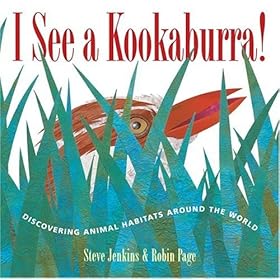
Jenkins, Steve and Robin Page. 2005. I SEE A KOOKABURRA!. Ill. by Steve Jenkins. New York, NY: Houghton Mifflin Company. ISBN 0618507647

2. PLOT SUMMARY:
Steve Jenkins and Robin Page create an awesome book that is sure to be a hit for teachers teaching about animal habitats. This book is well organized because one page shows the habitat as a whole and the next page shows each animal individually and labeling each animal with its name. The last pages of the book gives detailed information about the species habitat, describes its physical traits, and behaviors.

3. CRITICAL ANALYSIS:
Jenkins and Page put together a distinct feature into each page special characteristic into this book about animals and their habitats. The illustrations are made of bright collages that almost look three dimensional and some backgrounds are lush and have very small white background. However, on the next page when the objects are removed from the page have lots of white background giving the opportunity to describe the physical properties of the animals in that page. There is a language pattern of “I see…” The animals are hidden in their environment camouflaging in their habitat. Each page in this book has an ant because at the end of the book it tells that “ants live all over the world” This book has repetitive language to develop a sense of curiosity in the younger and older school children at home or at school. It can also serve as a vehicle with English Language Learners because it will develop oral language, teach about habitats, and learn to read and write the names of the animals as well as their habitat. This book is also helpful because it has a world map showing the six parts of the world that the author and illustrator use to create this wonderful book that lends itself to teaching different topics.

4. REVIEW EXCERPTS:
HORNBOOK, “In an appealing game of hide-and-seek, readers look at one of eight different habitats with glimpses of animals. Turn the page, and the plants and rocks are gone, revealing the animals. The lush cut-paper illustrations invite detailed scrutiny, but the plants seem to be more of a nuisance than critical components of the ecosystems. Nevertheless, readers will be attracted to this handsome book.”
BOOKLIST, “The animal illustrations are reprised in miniature at the close of the book, each one presented with brief facts in tiny type, which are apparently directed to adults or older kids sharing the book with young