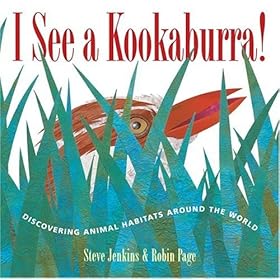
See a Kookaburra!
October 28, 2009
1. BIBLIOGRAPHY
Jenkins, Steve and Robin Page. 2005. I SEE A KOOKABURRA!. Ill. by Steve Jenkins. New York, NY: Houghton Mifflin Company. ISBN 0618507647
2. PLOT SUMMARY:
Steve Jenkins and Robin Page create an awesome book that is sure to be a hit for teachers teaching about animal habitats. This book is well organized because one page shows the habitat as a whole and the next page shows each animal individually and labeling each animal with its name. The last pages of the book gives detailed information about the species habitat, describes its physical traits, and behaviors.
3. CRITICAL ANALYSIS:
Jenkins and Page put together a distinct feature into each page special characteristic into this book about animals and their habitats. The illustrations are made of bright collages that almost look three dimensional and some backgrounds are lush and have very small white background. However, on the next page when the objects are removed from the page have lots of white background giving the opportunity to describe the physical properties of the animals in that page. There is a language pattern of “I see…” The animals are hidden in their environment camouflaging in their habitat. Each page in this book has an ant because at the end of the book it tells that “ants live all over the world” This book has repetitive language to develop a sense of curiosity in the younger and older school children at home or at school. It can also serve as a vehicle with English Language Learners because it will develop oral language, teach about habitats, and learn to read and write the names of the animals as well as their habitat. This book is also helpful because it has a world map showing the six parts of the world that the author and illustrator use to create this wonderful book that lends itself to teaching different topics.
4. REVIEW EXCERPTS:
HORNBOOK, “In an appealing game of hide-and-seek, readers look at one of eight different habitats with glimpses of animals. Turn the page, and the plants and rocks are gone, revealing the animals. The lush cut-paper illustrations invite detailed scrutiny, but the plants seem to be more of a nuisance than critical components of the ecosystems. Nevertheless, readers will be attracted to this handsome book.”
BOOKLIST, “The animal illustrations are reprised in miniature at the close of the book, each one presented with brief facts in tiny type, which are apparently directed to adults or older kids sharing the book with young

No comments:
Post a Comment