Tuesday, December 8, 2009

LS 5603 Lidia Bissell Book Review Module 5


BOOK REVIEW: THE MIDWIFE’S APPRENTICE
1. BIBLIOGRAPHY
Cushman, Karen THE MIDWIFE’S APPRENTICE. Houghton Mifflin, ISBN10: 0395692296
2. . PLOT SUMMARY
Karen Cushman’s historical fiction book, THE MIDWIFES’S APPRENTICE is the 1996 Newbery, Winner. In the beginning, a thirteen year old orphan girl without a named is called “Brat or Beetle”. The girl rests in a dung heap on a cold winter’s night. Jane the only midwife in the village discovers Beetle in the dung and the midwife makes Beetle work for bread. Beetle takes lots of verbal abuse from Jane and the boys in the poor village in the medieval period in England.
Beetle’s only companion is a cat who she tries to keep safe from the boys who terrorize her. Beetle begins to feel better about herself when she gives herself a name “Alyce”. She learns how to be a midwife by watching Jane the village’s midwife prepare herbs as medicine and delivering babies. Beetle manages to overcome insecurity in her skills until she manages to deliver a baby.
3. CRITICAL ANALYSIS
Cushman’s Newbery Winner novel, the MIDWIFE’S APPRENTICE, takes place in the medieval time period. Cushman’s character is nameless orphan young woman about “twelve or thirteen years-old” (2). Cushman develops the protagonist by simply having a name of her own instead of her name being “Brat or Beetle.” She gives herself permission to adopt the name “Alyce” after someone confuses her with someone else. She struggles at first but she decides to take that name because it gave her self-worth. This is the turning point in the character’s self discovery because it leads her to develop a sense of identity and self esteem.
Alyce feels positive about her and watches Jane the midwife preparing herbs that served as medicine. This is how she becomes the midwife’s apprentice because she made up her mind to learn. “twelve or thirteen years of age” (2). Cushman takes this homeless, nameless, and hungry orphan whose only company is a cat. Cushman makes the reader feel that the protagonist was dropped in the story without any background at the beginning or end of where she had being prior to the protagonist’s appearance.


Alyce is called to deliver a baby when Jane the midwife is not found but she does not have the courage to deliver the baby. After all night of Emma enduring contractions the midwife arrives and delivers the baby. Alyce realizes that the midwife did not use any magic to deliver the baby. However, Jane the antagonist, ridicules Alyce; this results in Alyce running away from the midwife. Alyce finds a job but is discontent because she likes being a midwife’s apprentice. She goes back to ask the midwife to take her back but the midwife refuses at first. This did not stop Alyce, she persisted and convince the midwife to let her come back. At this point Alyce is sure about what she wants in life and she sets out to learn as much as possible from the midwife and for her dreams to come true when she delivers a baby from a woman who was to have a worm in her stomach that kept her from having a baby. Alyce is now certain that delivering babies does not involve superstition. She feels good about herself because she knows that delivering a baby is all about a skill.

It is amazing how Cushman manages to show so much without writing a lot. She is able to create pictures in the reader’s mind about a foreign time period without telling a lot in this short story that is so realistic about overcoming obstacles through determination and perseverance to achieve one’s dreams.


4. EXCERPTS
The girl known only as Brat has no family, no home and no future until she meets Jane the Midwife and becomes her apprentice. As she helps the sharp-tempered Jane deliver babies, Brat--who renames herself Alyce--gains knowledge, confidence, and the courage to want something from life.
http://www.ecampus.com/bk_detail.asp?isbn=0395692296

5. CONNECTIONS

Matilda Bone, by Karen Cushman

Saturday, November 28, 2009

The Diary of a Wimpy Kid # 1


BOOK REVIEW 6
1. BIBLIOGRAPHY
Diary of a Wimpy Kid (Diary of a Wimpy Kid Series #1) April 2007 ISBN-13: 9780810993136
2. PLOT SUMMARY
The first book “Diary of a Wimpy Kid” is a must read for parents, children, and teachers because it offers a window as to how a middle school student survives leaving in a home with an older bother bossing him around, annoying younger, and clever parents. Gregg wants to be accepted by his peers and be popular at school. But, Greg is short and skinny and cannot get the attention he wants. He settles for the class clown to draw attention to himself. He and his best friend Rowley are constantly getting in trouble with kids from school. It is hilarious to see how Gregg’s ideas backfire on him and get him and Rowley in trouble. For instance, on Halloween, Greg and his best friend, Rowley, taunt high school bullies. Rowley and Greg take refuge from the bullies at Greg's grandmother's house. The bullies retaliate by covering grandmother’s house with toilet paper. Greg learns to navigate his first year of middle school and to accept himself by being him.
3. SUMMARY ANALYSIS
The author Kinney organizes this book beginning with the school year, months, birthdays, holiday celebrations, and special events. Mr. Kinney gives the readers a realistic view of middle school life told in the first person point of view of a six grader that manages to survive his first year in middle school. This novel is realistic and hilarious because of Kinney’s cleverness to create cartoon or toothpick figures as illustrations. Mr. Kinney brings the themes of sense of belonging, identity, and the adolescent phases that teenagers go through in this novel. Greg’s physical appearance puts him at a disadvantage because he is skinny and short. Bullies can come around and beat him up. Greg and Rowley make fun of senior bullies on Halloween and the bullies get even by covering his grandmother’s house with toilet paper. Greg does not show feelings of regret that his grandmother has to help Gregg to take to take the toilet paper off the trees. In another occasion, his clever father watches Greg kick the little brother’s snowman. In turn, his father crushes to pieces the enormous snowball that Greg and friends have put together to make the biggest snowman.
Greg is struggling with identity and insecurity because he is desperate to get attention. Rowley is getting lots of attention and sympathy from the girls because he has a broken arm in a cast. The girls with their names on the arm cast and immature and silly Greg spills out that he had something to do with Rowley’s broken arm. As usual this backfires on him and no one wants to have anything to do with Gregg. Next day he goes to school with a bandage hand and forearm asking the girls to sign their name but they do not show any interest.
Kinney ends the novel by showing Greg as a mature sixth grader vs. the immature Gregg at the beginning of the story. Gregg realizes that being you its okay and that one does not have to be a class clown, taunting people, pretending, and hurting others to be content. Greg is content with himself now and what makes this better is that Rowley and Greg are friends again.
4. EXCERPTS
NPR Community
The cartoons don't merely illustrate the story, they advance it and split it off into a hundred digressive tributaries, working like the footnotes in Eliot's Waste Land.
5. CONNECITONS
Diary of a Wimpy Kid: Rodrick Rules, Written and illustrated by Jeff Kinney

Jellicoe Road


BOOK REVIEW 6
BIBLIOGRAPHY
Melina Marchetta; Harper Teen; Publisher: New York, NY : HarperTeen, 2008, ©2006. ISBN-10: 0061431834
PLOT SUMMARY
Taylor is abandoned by her mother at a 7-Eleven store on Jellicoe Road where Hannah and her later caretaker takes Taylor to the Jellicoe Road State school and keeps Taylor under her wings. Taylor is in charge of one of the dorms and is the leader of Jellicoe’s School gang. Three gangs have a long history of gang rivalry and one of them is the cadets whose leader Jonah Griggs knows Taylor better than she knows herself. Taylor is in constant mental agony about being abandoned by her mother, her father’s death, and Hannah’s sudden disappearance. This propels her to start looking for answers about her past. She allows herself to have a relationship with Jonah Griggs and they set out on a journey to find her mother Tate or her whereabouts to bring closure to Taylor’s painful past that hunts her up till now and move forward.


SUMMARY ANALYSIS
Melina Marchetta’s novel JELLICOE ROAD winner of West Australian Young Readers’ Book Award (WAYRBA) for Avis Page Award (2008) and Printz Award (2009) for Excellence in Young Adult Literature is told from the first person point of view of a seventeen year old girl living in a state school due to her mother’s abandoning her when she was eleven years old. She is taken into Jellico School’s teacher Hannah who plays a mother figure for Taylor and this is the only world that Taylor knows. Melina Marchetta’s writing style in the first third of the book is difficult to read as Taylor throws words without any connection to anything else or point of reference. She takes the beginning of the story and weaves it back and forth to create different themes within the novel. She weaves them into different themes such as, adolescents dealing with identity crisis, abandonment, gangs, friendships, relationships, and most important finding peace with one self by accepting life as it is and moving forward.
The language in the book is engaging because of its familiarity of dealing with teenagers such as when Jonah tries to understand Taylor; “What do you want from me?” He asks. Taylor thinks to herself, “What I want from every person in my life, I want to tell him.” She is afraid that Jonah will see that she is desperate to have someone in her life that cares about her.

This writing style keeps reader turning the pages because just as a conflict is solved another arises leaving the readers with a mystery that must be solved. An example of that is when two gang leaders, Taylor and Jonah become friends they have clues about where Taylor’s mother is and they set out to find out about Taylor’s mother. During this journey, Taylor and Jonah Griggs take off the gang mask that covers the individual’s ability to care and love each other. They go back to Jellicoe Road where they find Taylor’s mother and that Taylor was left at the 7-Eleven because Hannah was going to pick her up. Taylor comes to peace with her mother who dies soon after that. Hannah has been taking care of others, Taylor and Jonah will have a long distance relationship.

4. EXCERPTS
From BOOKLIST
Taylor Markham isn’t just one of the new student leaders of her boarding school, she’s also the heir to the Underground Community, one of three battling school factions in her small Australian community (the others being the Cadets and the Townies). For a generation, these three camps have fought “the territory wars,” a deadly serious negotiation of land and property rife with surprise attacks, diplomatic immunities, and physical violence. Only this year, it’s complicated: Taylor might just have a thing for Cadet leader Jonah, and Jonah might just be the key to unlocking the secret identity of Taylor’s mother, who abandoned her when she was 11. In fact, nearly every relationship in Taylor’s life has unexpected ties to her past, and the continual series of revelations is both the book’s strength and weakness; the melodrama can be trying, but when Marchetta isn’t forcing epiphanies, she has a knack for nuanced characterizations and punchy dialogue. The complexity of the story will be off putting to younger readers, but those who stick it out will find rewards in the heartbreaking twists of Marchetta’s saga. Grades 9-12. --Daniel Kraus
CONNECTIONS
The Surrender Tree by Engle, Margarita
After Tupac and D Foster (Newbery Honor Book) (Hardcover) by Jacqueline Woodson

Joey Pigza loses control


BOOK REVIEW 6
1. BIBLIOGRAPHY
Gantos, Jack. (2000). Joey Pigza loses control. New York: Farrar, Straus and Giroux.

2. PLOT SUMMARY
Joey is an eleven year old boy who suffers from attention deficit hyperactivity disorder and has to have medicated patches to control his out of control hyperactivity. He is going to spend his summer vacation in a small town with his father to get to know him, and his chain smoker grandmother who has to carry an oxygen tank to help her breath. Joey’s parents are divorced and Joey hopes to bring their parents together to have a nuclear family. Joey soon finds out that his father is not interested in being with him and Joey’s mother. Joey’s father is irresponsible, selfish, and verbally abusive toward Joey. Carter shows his irresponsibility by flushing Joey’s medication down the toilet. The grandmother is verbally abusive toward Joey reminding him that it is a matter of time that he is going to loose control and taking Joey’s money away to buy cigarettes.


3. CRITICAL ANALYSIS
Jack Gantos’ National Book Award Finalist and Newbery Honor Award book JOEY’S PIGZA LOSES CONTROL is told from the first person point of view of an eleven year-old. The themes in the book are realistic and believable because chances are that either people experienced or know someone that has experienced one or more of the themes in this book; such as, divorce, alcoholism, chain smokers, and attention deficit hyperactivity disorder. The protagonist is Joey who is hopeful to mend his parents’ relationship and be together as a family. He is faced with the rude awakening that his father is still in a world of his own and he only cares about no one else but himself.
Joey’s father ignorant and selfish actions of peeling the medicated patch of Joey’s arm demonstrate his self- centeredness when he peels Joey’s patch of his arm, “ no more drugs” (93). Joey’s ADHD or hyperactive behavior can only be controlled with medication. The irony is that Carter has addictions and he does not have the will to control them. Jack Gantos, events and language in the book are so familiar and realistic that keeps the reader turning the pages. Joey and his mother are responsible because they have taken control of Joey’s illness by Joey taking the medication and attending a Special Education School that has helped him to stay focus and in control.
This is a funny story and one that brings you to tears because of the struggles the character goes through to get closer to his father and trying to keep himself under control with his own will and eventually failing because Joey knew that controlling himself is not about “ will”; it is a medical condition. Joey realizes that his father is selfish and does not have any intentions to be with him and his mother. Joey panics when he finds out that “he was an accident” or his mother became pregnant prior to been married. He calls his mother right away. She reassures him that she cares for him very much.
Joey develops as an individual because he realizes and accepts the fact that his father is selfish and only cares about his needs. The braking point in the story is when Joey has being without medication for a while and he knows that he is about to loose control when he thinks to himself, “All I could imagine was the worst part of me getting of a train a long ways off. That old Joey was coming to get me and I couldn’t do anything about it …There was nothing to do but wait and worry.” His father reassures him that he is going to be fine. Joey knows better and when he starts pitching the ball is going out in the parking lot braking car windows.
Another, irresponsible action on Joey’s father is when he tells him to let the pitcher hit him to get on base. Joey gets hit on the head but his father is not concerned with this hit to Joey’s head. He is concerned about winning the game and being recognized in the small town as the father of the excellent pitcher. The umpire is reassured by Joey’s dad that Joey is okay. This is so familiar of parents yelling, fussing, and embarrassing their children in front of the public. Joey cannot concentrate at all and has the courage to walk out of the field and ran away to get as far as possible from this man that he had hoped to have a father and son closed relationship.
4. EXCERPTS
SCHOOL LIBRARY JOURNAL: "Readers will be drawn in immediately to the boy's gripping first-person narrative and be pulled pell-mell through episodes that are at once hilarious, heartening as Joey grows to understand himself and the people around him. The ride home isn't smooth, but it is hopeful and loving. Does this mean that he is on the way to a happy, "normal" life? Grades 4-8.


5. CONNECTIONS
Gantos, Jack. Joey Pigza Swallowed the Key. ISBN 0064408337

Wednesday, November 11, 2009

Island of the Blue Dolphins


HISTORICAL FICTION BOOK REVIEW

1. BIBLIOGRAPHY
O’Dell, Scott. 1960. Island of the Blue Dolphins. New York: Bantam Doubleday Dell Books for Young Readers. ISBN 0440439884

2. PLOT SUMMARY
This is the 1960 Newbery Award winning tale of Karana, “The girl with the long black hair.” The story is based on the real life of Juana Maria who was part of the Nicoleno tribe that was stranded on the small San Nicholas Island after a series of tragic events. The small village of Ghalas gets visited by Aleuts who wished to hunt sea otters. Karana’s father reluctantly agrees to allow them to hunt in exchange for money. Aleuts attempted to leave without paying the tribe, resulting in a fight among the two groups. Karan’s father is killed among many others in the tribe. The new tribe’s chief leaves to seek and bring help to the tribe by taking them out of the island. Years go by and with every sight of a ship she hopes it’s the chief’s return. Finally, a ship sent by the Chief comes to take everyone away; everyone is on the ship except Karana’s brother, Ramo. The ship cannot wait for the boy because of a heavy storm coming their way which leads to Karana jumping off the ship. Karana’s brother later is killed by the dogs that were part of the tribe that have turned vicious. She mourns the loss of her brother, cries herself to sleep at night, and endures harsh weather and later is able to cope and survive. She learns to do jobs men would do that are considered a sin in her religion. However , Karana builds canoes, spears, and knows that her enemies are the Laetus and dogs. During her explorations, she remembers about the death whale’s bones and their location which she later learns to use them creatively and usefully to build a house. Karana discovers a cave that’s she makes a hiding place for water and necessary supplies. After killing some of the dog pack and injuring the leader she becomes at peace with them while nursing them back to health..
After sometime Karana grows and matures into a self reliant woman by keeping a realistic attitude about her situation. Later the Leauts return and bring a young woman servant which lead to a friendship between the two, soon Karana goes unnoticed. After eighteen years, a ship anchors at the island to hunt for otter’s pelt this is were Scott O’ Dell beautifully describes Karana’s thoughts of the white men. She dresses with sea otter pelt and its viewed as inappropriate for the Santa Barbara Civilization so they dress her in there attire.


3. CRITICAL ANALYSIS
Scott O’Dell’s historical fiction book, THE ISLAND OF THE BLUE DOLPHINS, a Newbery award winner gives some detailed information about the female character and history of her ancestors. Scott O’ Dell, provides the readers with “Author’s Notes” or research information at the end of the book by stating that, “The Island of the Blue Dolphins was first settled by indians in about 2000 B.C, but it was not discovered by white men until 1602.” He also estimates that Karana lived in the Island of the Blue Dolphins by herself from “1835-1853.” Scott O’ Dell, begins the story with Karana, the twelve year old girl with long black hair. The author describes the character as caring by doing things for the tribe’s benefit vs. herself. The story is told from the first person point of view. He develops the character with appropriate actions and thoughts of a twelve year old and continues this pattern simultaneously as Karana grows in maturity and age.
The author sets the tone in the first chapter by giving facts congruent with history details about explorers and Indian Tribes. Scott O’Dell provides us with this in chapter 1, when Karana or main character expresses her father’s description of Russians, ‘I had never seen a Russian before, but my father had told me about them and I wondered, seeing the way he stood with his feet set apart and his fists on his hips and looked at the little harbor as though it already belonged to him, if he were one of those men from the north whom our people feared. I was certain of it when the boat slid in to the shore and he jumped out, shouting as he did so." This creates pictures in the readers mind and touches on historical events. Furthermore, the author provides the reader with details about how explorers and Natives exchange goods with each other. In this case, the explorers “Leuts” were to pay money in exchange for permission to kill otters for their pelt. They brake their promise and many tribesmen are killed including Karan’s father.
The author sets the tone to touch on the theme of survival and overcoming barriers with Karana conflict with nature and self due to her religious beliefs. He also brings information that is congruent with historical events. This story is about how a girl made the island her home and used animals and nature her best friends. She learned to utilized death and living things by using the bones of dead whales to build shelter and fishing for food.
The book has author’s notes at the end of the book and provides facts about when the island was “…settled by Indians in 1600B.C., and how this woman Juana of San Nicolas was able to overcome her fears and survive in The Island of the Blue Dolphins for 18 years all by herself.


REVIEW EXCERPT(S)

"A haunting and unusual story based on the fact that in the early 1800s an Indian girl spent eighteen years alone on a rocky island far off the coast of California . . . A quiet acceptance of fate characterizes her ordeal." School Library Journal, Starred

A beautiful Indian girl stranded on an island off California makes her home with her brother while she awaits a rescue which will take years in O'Dell's moving classic story. Tantoo Cardinal's fine reading is enhanced by her background as an actress in this moving story, which comes alive in audio. -- Midwest Book Review
CONNECTIONS
Julie of the Wolves

eljah


HISTORICAL FICTION BOOK REVIEW

1. BIBLIOGRAPHY
Curtis, Christopher Paul. 2007. ELIJAH OF BUXTON. Scholastic Press. New York, NY. ISBN 9780439023443

2. PLOT
Christopher Curtis puts the reader in suspense, stress and sadness when he puts an eleven-year-old Black young boy out of his comfort zone of Buxton, Canada, a city founded by the arrival of slaves. Elijah goes from a worry free life to finding slaves in a barn in Detroit. This young scary and “fra-gile” boy was struck with the full blown reality of slavery. This happens when he goes to Detroit with Mr. Leroy is looking for the preacher that stole Mr. Leroy’s money to buy Mr. Leroy’s family out of slavery. The reader is completely at awe about how the author developed a scary eleven-year-old youth. He takes the character out of his known lifestylr in Baxton into Detroit to face the risk to be capture into slavery and never see his family again. Buxton, Canada has the reputation of welcoming and helping slaves to make it in to their town by rescuing them in the woods prior to entering town. Wow! This historical fiction story is one of finding the courage within us to do the right thing, just as Elijah finds the courage to go back to the barn where the slaves are for Ms. Chloe’s baby girl and takes her in to free territory where the Liberty Bell will ring because of the arrival of one more life to live free.


3. CRITICAL ANALYSIS
Christopher Curtis Newbery Honor Book Award crafts the historical fiction story by creating a solid setting in Buxton Canada where slaves that had escaped slavery had come to Buxton to live as free. The story is told by the first person point of view from Elijah an 11- year- old. He seems to be popular amongst friends because he is the first Black person to be born free. The author develops the character by what others think, and say about him. He is depicted as one who is scared of anything such as “rope shaped cookies.” However the characters actions contradict what others think about him. This is a character that one wants to get close because he is funny, witty, and has courage to do what is right. Elijah put himself in danger by crossing the Canada border in to Detroit and to risk being captured as a slave. He discovers slaves in a barn. He leaves the barn, slaves, and a baby girl behind. He puts himself at greater risk by going back for the baby and takes her to free territory founded by slaves that had escaped. Christopher Curtis protagonist builds suspense and emotion in the way he develops the character and tying this to history.
It is obvious that the author spent a great deal of time researching prior to writing this book. He spends lots of time talking about the setting where the character and its citizens live. I enjoy the way he creates this closed neat community who rings the Liberty Bell anytime a slave comes to their slave free territory created by their ancestors. However, it is amazing and brilliant the way he develops the protagonist Elijah.
This is literature that needs to be brought in the classrooms to show students that they can overcome difficult challenges. Students must find the courage inside them to do the right thing in their lives. This novel can be taught in a way of a timeline to unite, show, compare and contrast the past in the lives of slaves to know.

4. REVIEW EXCERPTS
RSchool Library Journal: Eleven-year-old Elijah Freeman has two claims to fame: he was the first free black to have been born in Buxton, an actual settlement in Canada established in 1849 by the abolitionist Reverend William King; and, during his infancy, he threw up all over the visiting Frederick Douglass. Elijah is an engaging protagonist, and whether he is completing his chores or lamenting his Latin studies or experiencing his first traveling carnival, his descriptions are full of charm and wonder. Although his colloquial language may prove challenging for some readers, it brings an authenticity and richness to the story that is well worth the extra effort that it might require. While some of the neighbors believe Elijah to be rather simple, and even his mother tends to overprotect her "fra-gile" boy, his true character shines out when a disaster occurs in the close community. Elijah's neighbor, Mr. Leroy, has been saving money for years to buy freedom for his wife and children who are still in the U.S. When this money is stolen, Elijah blames himself for inadvertently helping the thief and, risking capture by slave catchers, crosses the border into Detroit to get it back. His guileless recounting of the people he meets and the horrors he sees will allow readers to understand the dangers of the Underground Railroad without being overwhelmed by them. Elijah's decisions along the way are not easy ones, but ultimately lead to a satisfying conclusion. Curtis's talent for dealing with painful periods of history with grace and sensitivity is as strong as ever.—Kim Dare, Fairfax County Public Schools, VA School Library Journal, A Reed Business Information Publication
Publishers Weekly: Elijah Freeman, 11, has two claims to fame. He was the first child “born free” to former slaves in Buxton, a (real) haven established in 1849 in Canada by an American abolitionist. The rest of his celebrity, Elijah reports in his folksy vernacular, stems from a “tragical” event. When Frederick Douglass, the “famousest, smartest man who ever escaped from slavery,” visited Buxton, he held baby Elijah aloft, declaring him a “shining bacon of light and hope,” tossing him up and down until the jostled baby threw up—on Douglass. The arresting historical setting and physical comedy signal classic Curtis (Bud, Not Buddy ), but while Elijah's boyish voice represents the Newbery Medalist at his finest, the story unspools at so leisurely a pace that kids might easily lose interest. Readers meet Buxton's citizens, people who have known great cruelty and yet are uncommonly polite and welcoming to strangers. Humor abounds: Elijah's best friend puzzles over the phrase “familiarity breeds contempt” and decides it's about sexual reproduction. There's a rapscallion of a villain in the Right Reverend Deacon Doctor Zephariah Connerly the Third, a smart-talking preacher no one trusts, and, after 200 pages, a riveting plot: Zephariah makes off with a fortune meant to buy a family of slaves their freedom. Curtis brings the story full-circle, demonstrating how Elijah the “fra-gile” child has become sturdy, capable of stealing across the border in pursuit of the crooked preacher, and strong enough to withstand a confrontation with the horrors of slavery. The powerful ending is violent and unsettling, yet also manages to be uplifting.
Kirkus Reviews: Eleven-year-old Elijah Freeman is known for two things: being the first child born free in Buxton, Canada, and throwing up on the great Frederick Douglass. It's 1859, in Buxton, a settlement for slaves making it to freedom in Canada, a setting so thoroughly evoked, with characters so real, that readers will live the story, not just read it. This is not a zip-ahead-and-see-what-happens-next novel. It's for settling into and savoring the rich, masterful storytelling, for getting to know Elijah, Cooter and the Preacher, for laughing at stories of hoop snakes, toady-frogs and fish-head chunking and crying when Leroy finally gets money to buy back his wife and children, but has the money stolen. Then Elijah journeys to America and risks his life to do what's right. This is Curtis's best novel yet, and no doubt many readers, young and old, will finish and say, "This is one of the best books I have ever read."


5. CONNECTIONS
Have students work in small groups to create readers’ theater, write on journal, and have them understand that this story is to bring us together vs. separating us. This story is about what we can learn from the past.

Wednesday, October 28, 2009

LS Lidia Bissell


See a Kookaburra!
October 28, 2009

1. BIBLIOGRAPHY
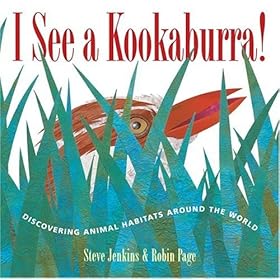
Jenkins, Steve and Robin Page. 2005. I SEE A KOOKABURRA!. Ill. by Steve Jenkins. New York, NY: Houghton Mifflin Company. ISBN 0618507647

2. PLOT SUMMARY:
Steve Jenkins and Robin Page create an awesome book that is sure to be a hit for teachers teaching about animal habitats. This book is well organized because one page shows the habitat as a whole and the next page shows each animal individually and labeling each animal with its name. The last pages of the book gives detailed information about the species habitat, describes its physical traits, and behaviors.

3. CRITICAL ANALYSIS:
Jenkins and Page put together a distinct feature into each page special characteristic into this book about animals and their habitats. The illustrations are made of bright collages that almost look three dimensional and some backgrounds are lush and have very small white background. However, on the next page when the objects are removed from the page have lots of white background giving the opportunity to describe the physical properties of the animals in that page. There is a language pattern of “I see…” The animals are hidden in their environment camouflaging in their habitat. Each page in this book has an ant because at the end of the book it tells that “ants live all over the world” This book has repetitive language to develop a sense of curiosity in the younger and older school children at home or at school. It can also serve as a vehicle with English Language Learners because it will develop oral language, teach about habitats, and learn to read and write the names of the animals as well as their habitat. This book is also helpful because it has a world map showing the six parts of the world that the author and illustrator use to create this wonderful book that lends itself to teaching different topics.

4. REVIEW EXCERPTS:
HORNBOOK, “In an appealing game of hide-and-seek, readers look at one of eight different habitats with glimpses of animals. Turn the page, and the plants and rocks are gone, revealing the animals. The lush cut-paper illustrations invite detailed scrutiny, but the plants seem to be more of a nuisance than critical components of the ecosystems. Nevertheless, readers will be attracted to this handsome book.”
BOOKLIST, “The animal illustrations are reprised in miniature at the close of the book, each one presented with brief facts in tiny type, which are apparently directed to adults or older kids sharing the book with young

Book Review: Harvesting Hope: The Story of Cesar Chavez
October 28, 2009

BIBLIOGRAPHY
Krull, Kathleen. 2003. Harvesting Hope: The Story of Cesar Chavez. Ill. by Yuyi Morales. New York : Harcourt, Inc. ISBN 0152014373

This is a children’s biography about Cesar Chavez who led and achieved the Farm Workers Labor Rights with peaceful protest fighting for better treatment and laws to protect the farm workers. Ms. Krull and Ms. Morales bring this well documented and colorful illustrated book to inform and entertain readers through the aesthetic beautiful illustrations to tell and show us about Cesar Chavez’ life and how he saw the injustices committed against farm workers day in and day out.
Cesar Chavez grew up in the hot baking Yuma Arizona Desert in the 1930’s with immediate siblings and extended family like cousins. All of this comes to an end due to a natural disaster of drought. The family is overcome with sadness about living their vast amount of land behind to go to California in search of farming jobs. Cesar is home sick for the Arizona land and the good times the family had together in their eighty acre farm and their life as a family. His family and many other adult and children workers are forced to work long hours in the baking sun, have poor housing conditions, and are paid minimum wages.
He starts to organize people to begin speaking out against the farm owners. He doubted himself because he was shy and did not see himself as a leader but people begin to listen to him. He organized the non violence march to strike against the farm owners for better pay, living conditions. He overcame this because he felt committed to fight for better working conditions, better pay, and better living conditions.

CRITICAL ANALYSIS
Ms. Krull’s research is documented in this book with facts that can be traced back to history, and Yuyi Morales visiting the territory enhance her illustrations with acrylic bright vivid colors and some browns. Yuyi Morales shows the characters with joy in their faces when the family is in Arizona. She goes on and skillfully illustrates the characters with sadness in their faces and fear of the farm overseers.
Ms. Krull’s biography of Cesar Chavez does not focus on his life from birth to death. Instead, it concentrates on Cesar Chavez’ life as a young boy, man, and on his persistence and commitment to have better working conditions for the farm workers.
This story is written in chronological order and shows the character’s strengths and weaknesses. The author and illustrator show Cesar Chavez as a young boy enjoying the hot shimmering sun, swimming, and enjoying the night with his family in their eight acre farm in the Yuma Arizona baked desert. The characters have faces filled with happiness. All of this comes to an in the 1930’s because of a drought. Cesar’s family has to migrate to California in search of farming jobs. The family of six works from dawn until sunset and is under the hot sun all day. The illustrator shows Cesar working bending down showing him very tired and the darkened background complements the text.
The family of six earned thirty cents a week altogether and was unable to save money. Their living conditions were terrible; they lived in a shack without a door, damp, cracks in the walls, and the cold and heat coming in. Yuyi shows two children with sad faces sitting at the front door and a truck driving at sun down.
Ms. Krull and Ms. Morales show how a shy boy endured the injustices of farm owners, and how he became the champion for labor workers by recruiting people to fight peacefully against the farm owners. In 1965, Cesar Chavez and many farm workers went on “La Huelga” On Strike” against the Delano farm vineyard owners for better pay and living conditions. The owners decided to cut their pay even more. By this time, the grapes were ripe, and the workers went in full strike. The farm owners lost big money because the workers went on strike. The owners finally recognized that recognize the “National Farm Workers Association”. They promised a contract with better pay and better working conditions.


REVIEW EXCERPTS

Horn Book (July/August, 2003)
“Krull, author of the excellent Lives Of series and Wilma Unlimited (rev. 9/96), depicts Chavez's early life on his family's ranch in Arizona as almost idyllic. Then in 1937, when he was ten, drought forced his family to give up the ranch and move to California. Migrant work was brutal, the conditions atrocious, and the pay minimal. Showing how Chavez developed into an advocate and spokesman, Krull focuses on the march he led from Delano to Sacramento as part of a grape-pickers strike; she offers vivid details of the over-three-hundred-mile march: "Cesar developed painful blisters right away. He and many others had blood seeping out of their shoes." The brief text creates a remarkably complex view of Chavez--his experiences and feelings. Krull's empathetic words are well paired with artist Yuyi Morales's mixed-media acrylic paintings, which are suffused with a variety of emotions, especially fear and sorrow…”
From School Library Journal
Grade 3-6-The dramatic story of Chavez's 340-mile march to protest the working conditions of migrant farm workers in California is the centerpiece of this well-told biography. Readers meet Chavez at his grandparents' home in Arizona where he lived happily amid a large extended family. His childhood was cut short when, due to financial difficulties, the family was forced to move to California to seek employment. After years of laboring in the fields, Chavez became increasingly disturbed by the inhuman living conditions imposed by the growers. The historic 1965 strike against grape growers and the subsequent march for "La Causa" are vividly recounted, and Chavez's victory-the agreement by the growers granting the workers better conditions and higher pay-is palpable. While sufficient background information is provided to support the story and encourage further research, focusing on one event makes the story appealing to younger readers. The text is largely limited to one side of a spread; beautifully rendered earth-toned illustrations flow out from behind the words and onto the facing page.
Sue Morgan, Tom Kitayama Elementary School, Union City, CA
Copyright 2003 Reed Business Information, Inc.

CONNECTIONS
This story would add understanding to a study about civil rights. Similarities and differences could be compared between the civil rights stories of Mexican Americans and African Americans.
Other Books about Mexican American Struggles
Perez, L. King. First Day in Grapes. ISBN 9781584300458Ada, Alma Flor. Gathering the Sun: An Alphabet in Spanish and English. ISBN 9780688139032

Nonfiction Lidia Bissell LS 5603


BOOK REVIEW

BIBLIOGRAPHY:
Bartoletti, Susan Campbell, Hitler Youth Growing Up in Hitler’s Shadow Scholastic Nonfiction New York 2005

PLOT SUMMARY
This book won two Awards, the Newbery Honor Award for the most distinguished contribution to children’s literature, and the Siebert Honor Award for its documentation. This is a book for youth and adults that show how one man preys on the young to carry his plan against humanity against Jewish people in the Holocaust. This well written book is bound to be an eye-opener particularly to the young to be mindful and cautious about leader’s agendas. It is beyond belief how Germany invaded and almost took over all of Europe by mainly using the young to carry out someone’s agenda. Young and old are euphoric about the promises of a better future for Germany. This plan is too registered as many young boys and girls to join Hitler’s Youth Army. These youngsters are to meet the criteria of both parents being Arian ethnicity and write an essay to ensure their belief in Hitler’s Socialist Party philosophy. This book sends chills through readers back to see how the youth flock to join this party and how they are manipulated by turning anyone in, including parents that disagree with Hitler’s philosophy. Girls train in strenuous endurance exercises to make them stronger physically and mentally. Soon youngsters begin to close down Jewish businesses and raiding their homes. The government is in total control and schools teach Hitler’s philosophy of a Germany of all Arian but do not teach German Jewish students. Some of the youth question themselves about the political philosophy that separates families, closes Jewish business, and the inability to have freedom of speech. Hitler’s Youth forms a group the “White Rose” to inform others about the party’s deceit on its citizens and about the crimes against humanity.


CRITICAL ANALYSIS

Ms. Bartolitti extensive research, interviews of survivors, bystanders, and photo media tells and shows how an evil dictator as Adolph Hitler, played on the innocence, sense of belonging, and patriotism on the youth to indoctrinated them to commit the worse crimes ever committed against humanity in the Holocaust or killing of Jewish people. HITLER’S YOUTH foreword cites the words coming from Hitler’s mouth to show that his plan was to use the youth to carry out his sinister plan –I begin with the young, said Hitler. “We older ones are used up….But my magnificent youngsters! Are there finer ones anywhere in the world? Look at all these men boys! What material! With them I can make a new world.”
Statements like the one just mentioned above, stories of individual youth, and the pictures makes this book hard to put down because it adds to the truth about the manipulation of young people to serve a murderer. This book is different than most books about Nazi crimes because it focuses on the youth and how they were used in WWII and became Hitler’s weapons to rid of anyone of Jewish dissent. The youngsters joined as young as seven years old. It was a crime to contradict Hitler’s beliefs and people were asked to report anyone who spoke against any of these political beliefs.
The youth’s party organization demanded loyalty when joining one had to bring birth certificates showing that they were full blood Germans. They had to go an extensive evaluation as well as to write an essay about their loyalty to Hitler’s party. Schools soon got rid of anyone who was not a full blood German, taught Hitler’s political philosophy, and the Jewish children were not allowed to attend school.
Ms. Bartolleti, does not make excuses for the youth that were brainwashed and indoctrinated in committing these crimes. Rather, she has all of these black and white pictures of individuals telling the story about them. She connects the text to the pictures brilliantly by keeping the reader fully engaged wanting to learn more about this topic of Hitler’s youth.
Bartoletti tells and shows how disagreeing with Hitler’s philosophy would get you killed. The author shares the story of individuals such as Sophie Scholl, who moved away from Nazi ideas as a teen and in college joined the "White Rose" group that published pamphlets detailing Nazi evils and urging people to put up a resistance. This was a crime a crime for which she and others were executed.
The majority of the pictures show Nazi propaganda showing euphoric, happy, and healthy teenagers as well as the sad reality of the concentration camps, and Nazis overtaken of Jewish people businesses and homes. This well documented book is written chronologically and it speaks as a challenge to all readers to keep on guard and not let anyone take over the young minds so that this will not ever be repeated again.

REVIEWS
2006 Newbery Honor Award
"How could the Holocaust have happened? Bartoletti delivers a chilling answer by exploring Hitler's rise to power through the first-hand experiences of young followers whose adolescent zeal he so successfully exploited and the more extraordinary few who risked certain death in resisting. The meticulously researched volume traces the Hitler Youth movement from the time it formally gathered strength in the early 1930s through the defeat of the Third Reich. The grace and clarity of the writing make Hitler Youth: Growing Up in Hitler's Shadow a powerful addition to Holocaust literature for children."

2006 Newbery Committee
American Library Association

2006 Sibert Honor Award
"Readers will be riveted by the chilling history meticulously documented in Susan Campbell Bartoletti's Hitler Youth: Growing Up in Hitler's Shadow. By weaving the personal stories of twelve young Germans into the larger fabric of Nazism and World War II, Bartoletti elevates understanding of Hitler's strategic plans of manipulation to a new level and offers contemporary youth the opportunity to question the choices they might have made in the same situation."

2006 Sibert Committee
American Library Association

Wednesday, October 14, 2009

Poetry 5603


BOOK REVIEW
GOOD LUCK GOLD
And Other Poems
1. BIBLIOGRAPHY:
Wong, Janet S. 1994. GOOD LUCK GOLD AND OTHER POEMS. New York: Margaret K. McElderry Books. ISBN 0689506171.
2. PLOT SUMMARY
GOOD LUCK GOLD, is an selection of poems by Janet Wong, and it brings light to first and second generation immigrants in the Asian heritage. These are valuable experiences to share with others ranging from family traditions, discrimination, divorce, alcoholism, and responsibilities. Each poem has a title, vary in length, and create strong feelings in the reader because of their direct language that speaks to the soul. This wonderful collection of poems will speak to the millions of children in this country who come from the Asian-and other-cultures. These children are normally viewed with some form of prejudice. This collection of poems will help others to become acceptant of their peers cultures and backgrounds.
3. CRITICAL SUMMARY

These poems form vivid pictures in the readers mind because they are honest and easy to understand. Ms. Wong shares her own experiences of being subjected to racism, stereotypes, and family. GOOD LUCK GOLD offers a variety of poems in length; some of these poems only have three lines while other are a page long, and others are written in haiku form. Some of these poems do not rhyme and others sound as if a conversation is taking place.

These poems are definitely to be read aloud and lend themselves to upper elementary through high school to teach culture sensitivity and tolerance, learn about other cultures, and respect for other cultures. Some poems in this collection bring light in to the Chinese and Korean families and how they cope with dangers situations of discrimination and racism. In the last poem of the selection TO CAGED BIRDS AT THE POULTRY STORE, Ms. Wong makes reference to the ducks at the bottom of suffocating pile. “Though waiting at the bottom’s tough, just when you have had enough you’ll see the butcher’s hands reach in—and trust me, you’re the ones who win.” A metaphor for the struggles and discrimination faced by many new Americans, it is best to stay out of sight without being notice than to be noticed and in danger.

REVIEW EXCERPTS
School Library Journal: “Children who live in cities with Chinese-American populations will recognize some of the images described--the ducks hanging in grocery-store windows, dim sum stands, parades with firecrackers and dragons. For others, these pieces provide an introduction to the sights and sounds of Chinese-American neighborhoods.”
Booklist: “Fresh, honest, and not at all reverential, these poems are simple dramatic monologues about growing up Asian American. The lines are short and very easy to read; the voices are strongly personal.”

CONNECTIONS
This collection is a starting point for students to research the Asian-American culture and its traditions.

Poetry 5603


BOOK REVIEW
PLEASE BURY ME IN THE LIBRARY
1. BIBLIOGROPHY
J. Patrick Lewis Illustrated By: Kyle M. Stone Houghton Mifflin Harcourt, April 2005
ISBN-13: 9780152163877

2. PLOT SUMMARY
This book of poetry is a collection around the theme of books and varies in reading difficulty; some of these poems are sure to be a hit because of its playful language such as in the "Three Haiku," Epitaph/ for a Devoted Lifelong Reader—Thank you for the plot. This book will help enrich children and adults vocabulary. This can be done at school or at home in a cozy spot with loved ones.
The titles of these poems range from appealing to younger or upper elementary school children such as, “What if Books Had Different Names”, for middle school age “The Big-Word Girl”, and for older audiences, “A classic”, and the reader’s favorite , “Please Bury Me in the Library”. This is a book of poems that can be taken anywhere to amuse oneself and others at any moment.

3. CRITICAL ANALYSIS
Kyle M. Stone the illustrator, uses acrylic paintings and mixed media illustrations to complement the illustrations to the text. Just as the reader’s favorite poem “Please Bury Me in the Library”. It shows the beautiful shiny acrylic painting of bookshelves in earth tones and books out of place to show that they have been read. Another one of the poems the reader enjoyed is "What if Books Had Different Names," sits next to a painting of a lobster-bibbed lamb waiting to tuck into a plate of green eggs and spam. This will sure make a connection to Dr. Seuss book, GREEN EGGS AND HAM. This poem makes reference to many titles in playful funny language that the listener or reader is sure to make connections with other books or poems.


4. REVIEW EXCERPTS
“Like Lewis's previous witty verse, the poems brim with wordplay, but they sometimes seem to be aimed at adults”~ Publisher’s Weekly
“The lively rhymes are exuberantly matched by Kyle Stone's acrylics, which create their own strange world of lambs eating green eggs, butterflies nagging in aprons and a pigtailed girl riding a paper airplane into the mysterious night.” ~ Children’s Literature

5. CONNECTIONS
This great book can be used with older students. It could also be used along with a study of the importance of literary references.

Poetry 5603


BOOK REVIEW
OUT OF THE DUST

1. BIBLIOGRAPHY: Hesse, Karen. OUT OF THE DUST New York : Scholastic,
1997. IL 5-8 ISBN 0590360809

2. PLOT SUMMARY
Karen Hesee Newbery Award Medal and Scott O'Dell’s Historical Fiction Award is a novel written in verse poem about the natural ecological disaster due to the misuse of harvesting land and erosion that leaves the farming landing community in poverty and oppressed in this hot, poor, and suffocating place. Billie Joe the 14-year old girl struggles with the daily suffocating clouds of dust blowing day after day, the lose of her mother in a careless fire accident that claimed Billie Joe’s mother and baby brother’s life, and the silence between she and her father after Billie Jo’s mother dies. Billie Joe’s only joy of playing the piano comes to a long stop because she cannot play the piano anymore due to the damage done to her hands in the accident.
This poignant novel tells about lose of friends as they move west in hopes of better life away from the 1930’s Depression and the Dust Ball. Billie Jo’s father has cancer tumors on his skin and Billie Jo asks the doctor for help on her hands. The doctor comments “They’ll heal up fine if you just use them.” Billie Jo listens to his advice. “And I’ve/been playing/a half hour/every day,/making the skin stretch,/making the scars stretch.” This is how the story begins to end by Billie Jo and her father healing as a whole in every way use of her hands by playing the piano again even it is painful. This determined and resilient 14-year-old girl endures the pain and succeeds at playing the piano again.
Things finally begin to get better as her father meets a woman and forms a relationship with her and it begins to rain. This is definitely historical fiction that informs the reader about the struggles people endured during this time periods. It shows how hope and determination like that of a young teenager overcame anger and blame toward her father that could have abandoned her but decided to stay with her. Billie Jo runs away, and spends a lot of time thinking about what happened to her family. She even discusses her father with a male stranger she meets in the train. “I told him about my father,/and how the thing that scared us both the most/was being left alone./ And now I’d gone and left him.” She realizes that she needs to go back home to her father because this place is what made her what she is and she cannot turn her back on her father.


3. CRITICAL ANALYSIS
This Newbery Winner realistic novel OUT OF THE DUST written in free verse is grim, creates melancholy, heart wrenching, and gives hope to readers about overcoming many obstacles in life. This narrative is organized like a diary which makes it more real with dated entries from the winter of 1934 to winter 1935. Karen Hesse adds a title to each poem according to Billie Jo’s life circumstances at that time. This enables the reader to bring the character to life with courage, emotion, strong spirit, and determination.
This novel is a page turner and it brings clear images of the dry and violent dust ball storms, barren, and unfertile Oklahoma terrain full of despair, silence, blame, anger, and poverty to immerse and engage the reader in this compelling story of suffering, resilience, and overcoming obstacles.

Billie Jo shares with the reader her thoughts about the dust when she says, “I sensed it before I knew it was coming /I heard it,/smelled it,/tasted it./Dust.” Adults and children who read this book of poetry will be able to feel and see the resilience of the people who lived through the 1930’s Depression and Dust Bowl in Central Unites States. Karen Hesse’s vivid language in her poetry novel OUT OF THE DUST makes the reader feel the hapless and suffocating environment as a whole. The dust is clung to Billie Jo; it does not stop or let go. “While we sat/taking our six-weeks test, /the wind rose/and the sand blew/right through the cracks in the schoolhouse wall....”

The vivid description of the accident that ends the life of Billie Jo’s mother and baby brother is brief but powerful because of the impact it had on Billie Jo and her father is felt throughout the rest of the story. These feelings are about blame, anger, and forgiveness like when she says, As she opens up to Daddy, she begins to forgive him—and herself. “As we walk together,/side by side,/in the swell of dust,/I am forgiving him, step by step,/for the pail of kerosene./ Billie Jo had to come to terms with herself admitting the anger and blame toward her father and herself propelled her to move forward away from those feelings and made peace with her father and herself. Even though this is a novel, it is difficult to pinpoint a climax in the story because it has the daily struggle of survival on verse poems and diary form where humans fight humans overcoming nature. This novel lands itself too many different teaching topics. They can range from diary writing, poetry, history, and fifth grade earth science.


4. REVIEW EXCERPTS
Booklist, starred review- "A powerfully compelling tale of a girl with enormous strength, courage, and love."

Publishers Weekly, starred review- "Readers may find their own feelings swaying in beat with the heroine's shifting moods."

School Library Journal, starred review- "Free-verse poems allow the narrator to speak for herself much more eloquently that would be possible in standard prose."
5. CONNECTIONS
Out of the Dust should be used as a classroom read aloud for older children and young adults. The thematic elements include the Great Depression, the Dust Bowls of the 1930's, losing a parent, and of free verse poetry.
Other books and stories to use when studying Out of the Dust:
A Guide for Using Out of the Dust in the Classroom by Sarah Clark, 2004
Out of the Dust (Literature Circle Guides, Grades 4-8, by Tara McCarthy, 2003
Children of the Dust Bowl: The True Story of the School at Weedpatch Camp by Jerry Stanley, 1993

Wednesday, September 30, 2009

AND THE GREEN GRASS GREW ALL AROUND: FOLK POETRY FROM EVERYONE


REVIEW

1.BIBLIOGRAPHY:
Schwartz, Alvin. 1992. AND THE GREEN GRASS GREW ALL AROUND: FOLK POETRY FROM EVERYONE. Ill by Sue Truesdell. U.S.A.: Harper Collins Publishers. ISBN: 0060227575.

2.PLOT SUMMARY

Older readers are most likely to remember some of the poetry, riddles, rhymes and taunts from familiar folklore, and written by topic in, AND THE GREEN GRASS GREW ALL AROUND. The creative Alvin Schwartz organizes his work by topics ranging from People, Food, School, Wishes—and Warnings, Riddles, A Tree, and more. Older readers will remember many of the street rhymes from their own childhood like jump rope games, taunts, and songs. Most children in public schools probably do not know any of the items in this golden selection. The collection is also diverse in that it offers short poems and long poems such as “On top of spaghetti, All covered with cheese, I lost my poor meatball, When somebody sneezed.” The caricature like drawings pulls the collection together. In addition to organizing his work by topic, Alvin Schwartz, treats the readers to a section of useful resources, notes, and abbreviations.

3.CRITICAL ANALYSIS

While this collection will be known to some adults, the majority of children in public schools will not be familiar with these rhymes. Despite that, this great collection will appeal to most because of the variety of themes like, “Row, row, row your boat Gently down the stream, Throw your teacher overboard And you will year her scream.”) Children will definitely enjoy most of the silly rhymes and riddles because they are easy to remember due to the playful language. Alvin Schwartz and Sue Truesdell collection is impressive because of the text, jingles, and Shel Silverstein’s look alike illustrations that create a composition where everything is put together to elicit feelings of joy in the reader.

4.EXCERPTS

School Library Journal: “A marvelous book that is sure to become a classic.”

CONNECTIONS
An opportunity to explore and encourage poetry on an accessible and often hilarious level with younger children to develop language and reading.

Just in Case: A trickster Tale and Spanish alphabet book


REVIEW

1. BIBLIOGRAPHY: April 05, 2009: Morales, Y. (2008). Just in Case: A trickster Tale and Spanish alphabet book. New York: Roaring Brook Press. 1596433299

2. PLOT SUMMARY

Yuyi Morales work in the Spanish Alphabet book JUST IN CASE takes us into traditional folktale cultural literature for the celebrations of the “Day of the Dead.” The story begins in the Ghost Senor Calvera’s house. The ghost is meticulously getting ready by wearing a fedora hat and stripped tie to celebrate Grandma Beetle’s Birthday. As he is riding along in the night Senor Calvera is stopped by Zelmiro the Ghost who admonishes him for not taking a present to Grandma Beettle. But, instead of one gift, Senor Calvera wants to take a present that begins with each letter of the Spanish alphabet to make sure he gives something to Grandma that she will like. It is exhausting to see the illustrations of Senor Calvera trying to find the gifts to match with each letter of the alphabet. He begins with “Una Acordéon: An accordion for her to dance to. Bigotes: A mustache because she has none. Cosquillas: Tickles to make her laugh”. In the end, Grandma Beetle gets her best present, and that is to be surrounded by people she loves.

3. CRITICAL ANALYSIS


Yuyi Morales’ bright rich colors appeal to the eye because of the thin line drawn illustrations add space and balance to the pages in this trickster tale to grab the reader’s attention. This traditional folktale trickster Spanish alphabet story is cultural relevant with the lively and outgoing ghost characters to entertain children and adults on the “Day of the Dead” celebration. It also includes a dictionary with pictures on the first page as the as the reader opens the book and on the last page.

4. EXCERPTS

—Reforma “A perfect read aloud picture book for a birthday party celebration, grandmother’s day, el dia de los muertos or any time of the year. Highly recommended.”

CONNECTIONS
The Graveyard Book by Neil Gaiman and illustrated by Dave McKean

LS 5603 Traditional Folktale Genre Lidia Bissell- BUBBA THE COWBOY PRINCE: A FRACTURED TEXAS TALE


REVIEW

1. BIBLIOGROPHY: Ketteman, Helen. 1997. BUBBA THE COWBOY PRINCE: A FRACTURED TEXAS TALE. Ill. by James Warhola. New York: Scholastic Press. ISBN 0590255061.

2. PLOT SUMMARY


This fractured Cinderella story featuring a cowboy prince in the hot and dried Texas ranch where he is bossed around and mistreated by his stepbrothers Milton and Dwayne. Warhola is so creative and magical to portray a cow as a “fairy godcow” to take Bubba to the ball given by a rich lady rancher with a full head of tall blonde hair, and fingers glowing with jewels. Miz Laurleen owns ``the biggest spread west of the Brazos'' and is lonely. She wants a true cowboy to help her tend to the ranch. This fractured Cinderella is hilarious and full of surprises; it has this funny Texas colloquial speech that keeps the reader laughing, especially, when Laurleen mentions that she is looking for a cowboy “…cute as a cow’s ear.” As the magic continues, blonde hair Miz Laurleen dressed in cowgirl attire chooses Bubba to dance with while the rest of the cowboys try to figure out who the cowboy is and the magic runs out, Bubba has to run away from the ball. As most Cinderella’s stories, Miz Laurleen tracks Bubba down and they take off riding in to the Texas sunset leaving the Step dad, Wayne and Milton behind.

3. CRITICAL ANALYSIS


The modern fractured Cinderella folktale is Texan, entertaining, with cartoon like characters dressed as cowboys, and a rich Texan female. The dry setting and ranch full of chores compliment the text that keeps the reader wondering about the next surprise. Keeteman and Warhola’s fractured tall tale brings out modern times to portray women as independent and in charge of their own affairs. This Cinderella story with a Texas flavor is a delight.

4. EXCERPTS


School Library Journal
This is a fun-filled story with more hyperbole than a Christmas turkey has stuffing.

CONNECTIONS:


Comparing and contrasting versions of Cinderella can be an informative excursion into literature and culture.

Sunday, September 13, 2009


REVIEW

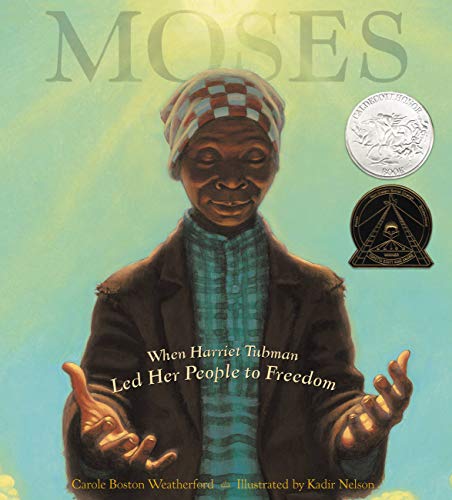
1. BIBLIOGRAPHY: Boston Weatherford, Carole. MOSES 2006. Ill. Nelson Kadir. New York, New York. ISBN: 0-7868-5175-9

2. PLOT SUMMARY
The children’s picture book MOSES won a distinguished Honor in the Caldecott for illustrations and the Coretta King Award for African American Literature. This historical fiction book appeals to young and adult readers to learn about slavery, survival theme of faith, resilience, and perseverance to help others.

3. CRITICAL ANALYSIS
The text and the illustrations in the book MOSES complement each other. Harriet is in an ongoing conversation with God and when God answers, the letters are all caps. Most of the illustrations here are darker when the character is in most danger alone and later going back to the south to rescue slaves. The illustrator’s picture of Harriet show a physically strong woman in body and the text complements her strong soul full of faith and commitment to help others.

4. EXCERPTS
From School Library JournalStarred Review.” Tubman's religious faith drives this handsome, poetic account of her escape to freedom”

5. CONNECTIONS
Coles, Robert. 1995. THE STORY OF RUBY Ill. Ford George. Scholastic Press. ISBN: 0590572814

Saturday, September 12, 2009

Book Review

1. BIBLIOGRAPHY Cummings, Pat. 1992. TALKING WITH ARTISTS. New York, NY: Bradbury Press. ISBN-10: 0027242455; ISBN-13: 978-0027242454.

PLOT SUMMARY

2.This is a book that sheds light on children books illustrators, illustrating techniques, usage of color, and types of paints they use ranging from pastel water colors to oil paints. A common element to be found in this book is that these illustrators began painting at a very young age about themes from their environment and now often placing people close to them as the characters in the story. This is an inspiring book that encourages children to young children who enjoy drawing to continue this to improve their drawing skills. This collection of artists sharing things about their life and their job is an eye opener to educators to be cognizant of children’s drawing abilities and the different types of illustrating or drawing artists they can become.

CRITICAL ANALYSIS

3. This book brings the readers close to the illustrators by bringing them into their world and illustrating career. The readers feel engaged with each one of these artists who share about how they knew at a very young age before fifth grade that they wanted to become illustrators. Their environment played a great deal of influence in their career because most of them had the freedom to use everyday objects found at home to draw or make collages without anyone bothering their area. The illustrators share their daily routine and describe their open space environment with plenty of windows.

REVIEW EXCERPTS
Boston Globe: Horn Book Award
BOOKLIST
“A special treat for budding artists and wonderful for teachers.”
SCHOOL LIBRARY JOURNAL
“Full insight and inspiration, this is an entertaining resource that young people, teachers and librarians will enjoy.”


CONNECTIONS

Carle, Eric. 1981. THE VERY HUNGRY CATERPILLAR. Philomel. ISBN:- 0399208534

PICTURE BOOK

REVIEW

1. BIBLIOGRAPHY Swanson, Susan Marie. 2009. THE HOUSE IN THE NIGHT. Ill. by Krommes Beth.

Boston: Houghton Mifflin Harcourt 2008: ISBN-13:978 0 618 86244 3 ISBN-10: 0 618 86244 7

1. PLOT SUMMARY

THE HOUSE IN THE NIGHT rhyme and repetitive words is pleasant to the ear and mind by immersing the reader into this wonderful story. The plot is a sequential order that is a cyclical story beginning with how a child receives a key and goes through the process of getting ready for bed where a book is waiting to be read by the child and the bird in the book takes him through and adventure of flying and watching the night unfold including the moon as it reflects light from the sun to keep light at night until morning comes.

2. CRITICAL ANALYSIS

THE HOUSE IN THE NIGHT deals on how people relax and enjoy reading by having a powerful story that immerses the reader into the book’s pleasant journey. This Caldecott winner book has universal implications because it starts at home and connects it to passing of time at night.

The majority of this book is illustrated in black and white with some burnt yellow text that brings light to the setting in this cyclical story that begins at night showing the color of the sun burnt yellow and about half way set, working itself to night, and eventually back to morning till full sunlight appears.

Despite the darkness of night in the town, the scratched board illustrator’s method, adds texture, tapestry, and brings light to the pages.

3. REVIEW EXCERPT(S)


Children’s Literature
"This old-fashioned story structure is pictured in scratch board with touches of yellow watercolor to create light."
School Library Journal
"A journey both humble and epic begins with a key to a house."

CONNECTIONS
Wanda Gag, 2006 MILLIONS OF CATS. Puffin ISBN:10: 0142407089 ISBN-13: 978014240708