Wednesday, October 28, 2009

LS Lidia Bissell


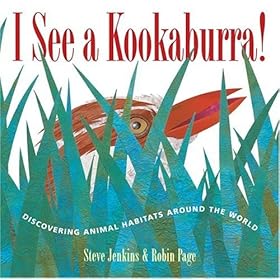
See a Kookaburra!
October 28, 2009

1. BIBLIOGRAPHY
Jenkins, Steve and Robin Page. 2005. I SEE A KOOKABURRA!. Ill. by Steve Jenkins. New York, NY: Houghton Mifflin Company. ISBN 0618507647

2. PLOT SUMMARY:
Steve Jenkins and Robin Page create an awesome book that is sure to be a hit for teachers teaching about animal habitats. This book is well organized because one page shows the habitat as a whole and the next page shows each animal individually and labeling each animal with its name. The last pages of the book gives detailed information about the species habitat, describes its physical traits, and behaviors.

3. CRITICAL ANALYSIS:
Jenkins and Page put together a distinct feature into each page special characteristic into this book about animals and their habitats. The illustrations are made of bright collages that almost look three dimensional and some backgrounds are lush and have very small white background. However, on the next page when the objects are removed from the page have lots of white background giving the opportunity to describe the physical properties of the animals in that page. There is a language pattern of “I see…” The animals are hidden in their environment camouflaging in their habitat. Each page in this book has an ant because at the end of the book it tells that “ants live all over the world” This book has repetitive language to develop a sense of curiosity in the younger and older school children at home or at school. It can also serve as a vehicle with English Language Learners because it will develop oral language, teach about habitats, and learn to read and write the names of the animals as well as their habitat. This book is also helpful because it has a world map showing the six parts of the world that the author and illustrator use to create this wonderful book that lends itself to teaching different topics.

4. REVIEW EXCERPTS:
HORNBOOK, “In an appealing game of hide-and-seek, readers look at one of eight different habitats with glimpses of animals. Turn the page, and the plants and rocks are gone, revealing the animals. The lush cut-paper illustrations invite detailed scrutiny, but the plants seem to be more of a nuisance than critical components of the ecosystems. Nevertheless, readers will be attracted to this handsome book.”
BOOKLIST, “The animal illustrations are reprised in miniature at the close of the book, each one presented with brief facts in tiny type, which are apparently directed to adults or older kids sharing the book with young

Book Review: Harvesting Hope: The Story of Cesar Chavez
October 28, 2009

BIBLIOGRAPHY
Krull, Kathleen. 2003. Harvesting Hope: The Story of Cesar Chavez. Ill. by Yuyi Morales. New York : Harcourt, Inc. ISBN 0152014373

This is a children’s biography about Cesar Chavez who led and achieved the Farm Workers Labor Rights with peaceful protest fighting for better treatment and laws to protect the farm workers. Ms. Krull and Ms. Morales bring this well documented and colorful illustrated book to inform and entertain readers through the aesthetic beautiful illustrations to tell and show us about Cesar Chavez’ life and how he saw the injustices committed against farm workers day in and day out.
Cesar Chavez grew up in the hot baking Yuma Arizona Desert in the 1930’s with immediate siblings and extended family like cousins. All of this comes to an end due to a natural disaster of drought. The family is overcome with sadness about living their vast amount of land behind to go to California in search of farming jobs. Cesar is home sick for the Arizona land and the good times the family had together in their eighty acre farm and their life as a family. His family and many other adult and children workers are forced to work long hours in the baking sun, have poor housing conditions, and are paid minimum wages.
He starts to organize people to begin speaking out against the farm owners. He doubted himself because he was shy and did not see himself as a leader but people begin to listen to him. He organized the non violence march to strike against the farm owners for better pay, living conditions. He overcame this because he felt committed to fight for better working conditions, better pay, and better living conditions.

CRITICAL ANALYSIS
Ms. Krull’s research is documented in this book with facts that can be traced back to history, and Yuyi Morales visiting the territory enhance her illustrations with acrylic bright vivid colors and some browns. Yuyi Morales shows the characters with joy in their faces when the family is in Arizona. She goes on and skillfully illustrates the characters with sadness in their faces and fear of the farm overseers.
Ms. Krull’s biography of Cesar Chavez does not focus on his life from birth to death. Instead, it concentrates on Cesar Chavez’ life as a young boy, man, and on his persistence and commitment to have better working conditions for the farm workers.
This story is written in chronological order and shows the character’s strengths and weaknesses. The author and illustrator show Cesar Chavez as a young boy enjoying the hot shimmering sun, swimming, and enjoying the night with his family in their eight acre farm in the Yuma Arizona baked desert. The characters have faces filled with happiness. All of this comes to an in the 1930’s because of a drought. Cesar’s family has to migrate to California in search of farming jobs. The family of six works from dawn until sunset and is under the hot sun all day. The illustrator shows Cesar working bending down showing him very tired and the darkened background complements the text.
The family of six earned thirty cents a week altogether and was unable to save money. Their living conditions were terrible; they lived in a shack without a door, damp, cracks in the walls, and the cold and heat coming in. Yuyi shows two children with sad faces sitting at the front door and a truck driving at sun down.
Ms. Krull and Ms. Morales show how a shy boy endured the injustices of farm owners, and how he became the champion for labor workers by recruiting people to fight peacefully against the farm owners. In 1965, Cesar Chavez and many farm workers went on “La Huelga” On Strike” against the Delano farm vineyard owners for better pay and living conditions. The owners decided to cut their pay even more. By this time, the grapes were ripe, and the workers went in full strike. The farm owners lost big money because the workers went on strike. The owners finally recognized that recognize the “National Farm Workers Association”. They promised a contract with better pay and better working conditions.


REVIEW EXCERPTS

Horn Book (July/August, 2003)
“Krull, author of the excellent Lives Of series and Wilma Unlimited (rev. 9/96), depicts Chavez's early life on his family's ranch in Arizona as almost idyllic. Then in 1937, when he was ten, drought forced his family to give up the ranch and move to California. Migrant work was brutal, the conditions atrocious, and the pay minimal. Showing how Chavez developed into an advocate and spokesman, Krull focuses on the march he led from Delano to Sacramento as part of a grape-pickers strike; she offers vivid details of the over-three-hundred-mile march: "Cesar developed painful blisters right away. He and many others had blood seeping out of their shoes." The brief text creates a remarkably complex view of Chavez--his experiences and feelings. Krull's empathetic words are well paired with artist Yuyi Morales's mixed-media acrylic paintings, which are suffused with a variety of emotions, especially fear and sorrow…”
From School Library Journal
Grade 3-6-The dramatic story of Chavez's 340-mile march to protest the working conditions of migrant farm workers in California is the centerpiece of this well-told biography. Readers meet Chavez at his grandparents' home in Arizona where he lived happily amid a large extended family. His childhood was cut short when, due to financial difficulties, the family was forced to move to California to seek employment. After years of laboring in the fields, Chavez became increasingly disturbed by the inhuman living conditions imposed by the growers. The historic 1965 strike against grape growers and the subsequent march for "La Causa" are vividly recounted, and Chavez's victory-the agreement by the growers granting the workers better conditions and higher pay-is palpable. While sufficient background information is provided to support the story and encourage further research, focusing on one event makes the story appealing to younger readers. The text is largely limited to one side of a spread; beautifully rendered earth-toned illustrations flow out from behind the words and onto the facing page.
Sue Morgan, Tom Kitayama Elementary School, Union City, CA
Copyright 2003 Reed Business Information, Inc.

CONNECTIONS
This story would add understanding to a study about civil rights. Similarities and differences could be compared between the civil rights stories of Mexican Americans and African Americans.
Other Books about Mexican American Struggles
Perez, L. King. First Day in Grapes. ISBN 9781584300458Ada, Alma Flor. Gathering the Sun: An Alphabet in Spanish and English. ISBN 9780688139032

Nonfiction Lidia Bissell LS 5603


BOOK REVIEW

BIBLIOGRAPHY:
Bartoletti, Susan Campbell, Hitler Youth Growing Up in Hitler’s Shadow Scholastic Nonfiction New York 2005

PLOT SUMMARY
This book won two Awards, the Newbery Honor Award for the most distinguished contribution to children’s literature, and the Siebert Honor Award for its documentation. This is a book for youth and adults that show how one man preys on the young to carry his plan against humanity against Jewish people in the Holocaust. This well written book is bound to be an eye-opener particularly to the young to be mindful and cautious about leader’s agendas. It is beyond belief how Germany invaded and almost took over all of Europe by mainly using the young to carry out someone’s agenda. Young and old are euphoric about the promises of a better future for Germany. This plan is too registered as many young boys and girls to join Hitler’s Youth Army. These youngsters are to meet the criteria of both parents being Arian ethnicity and write an essay to ensure their belief in Hitler’s Socialist Party philosophy. This book sends chills through readers back to see how the youth flock to join this party and how they are manipulated by turning anyone in, including parents that disagree with Hitler’s philosophy. Girls train in strenuous endurance exercises to make them stronger physically and mentally. Soon youngsters begin to close down Jewish businesses and raiding their homes. The government is in total control and schools teach Hitler’s philosophy of a Germany of all Arian but do not teach German Jewish students. Some of the youth question themselves about the political philosophy that separates families, closes Jewish business, and the inability to have freedom of speech. Hitler’s Youth forms a group the “White Rose” to inform others about the party’s deceit on its citizens and about the crimes against humanity.


CRITICAL ANALYSIS

Ms. Bartolitti extensive research, interviews of survivors, bystanders, and photo media tells and shows how an evil dictator as Adolph Hitler, played on the innocence, sense of belonging, and patriotism on the youth to indoctrinated them to commit the worse crimes ever committed against humanity in the Holocaust or killing of Jewish people. HITLER’S YOUTH foreword cites the words coming from Hitler’s mouth to show that his plan was to use the youth to carry out his sinister plan –I begin with the young, said Hitler. “We older ones are used up….But my magnificent youngsters! Are there finer ones anywhere in the world? Look at all these men boys! What material! With them I can make a new world.”
Statements like the one just mentioned above, stories of individual youth, and the pictures makes this book hard to put down because it adds to the truth about the manipulation of young people to serve a murderer. This book is different than most books about Nazi crimes because it focuses on the youth and how they were used in WWII and became Hitler’s weapons to rid of anyone of Jewish dissent. The youngsters joined as young as seven years old. It was a crime to contradict Hitler’s beliefs and people were asked to report anyone who spoke against any of these political beliefs.
The youth’s party organization demanded loyalty when joining one had to bring birth certificates showing that they were full blood Germans. They had to go an extensive evaluation as well as to write an essay about their loyalty to Hitler’s party. Schools soon got rid of anyone who was not a full blood German, taught Hitler’s political philosophy, and the Jewish children were not allowed to attend school.
Ms. Bartolleti, does not make excuses for the youth that were brainwashed and indoctrinated in committing these crimes. Rather, she has all of these black and white pictures of individuals telling the story about them. She connects the text to the pictures brilliantly by keeping the reader fully engaged wanting to learn more about this topic of Hitler’s youth.
Bartoletti tells and shows how disagreeing with Hitler’s philosophy would get you killed. The author shares the story of individuals such as Sophie Scholl, who moved away from Nazi ideas as a teen and in college joined the "White Rose" group that published pamphlets detailing Nazi evils and urging people to put up a resistance. This was a crime a crime for which she and others were executed.
The majority of the pictures show Nazi propaganda showing euphoric, happy, and healthy teenagers as well as the sad reality of the concentration camps, and Nazis overtaken of Jewish people businesses and homes. This well documented book is written chronologically and it speaks as a challenge to all readers to keep on guard and not let anyone take over the young minds so that this will not ever be repeated again.

REVIEWS
2006 Newbery Honor Award
"How could the Holocaust have happened? Bartoletti delivers a chilling answer by exploring Hitler's rise to power through the first-hand experiences of young followers whose adolescent zeal he so successfully exploited and the more extraordinary few who risked certain death in resisting. The meticulously researched volume traces the Hitler Youth movement from the time it formally gathered strength in the early 1930s through the defeat of the Third Reich. The grace and clarity of the writing make Hitler Youth: Growing Up in Hitler's Shadow a powerful addition to Holocaust literature for children."

2006 Newbery Committee
American Library Association

2006 Sibert Honor Award
"Readers will be riveted by the chilling history meticulously documented in Susan Campbell Bartoletti's Hitler Youth: Growing Up in Hitler's Shadow. By weaving the personal stories of twelve young Germans into the larger fabric of Nazism and World War II, Bartoletti elevates understanding of Hitler's strategic plans of manipulation to a new level and offers contemporary youth the opportunity to question the choices they might have made in the same situation."

2006 Sibert Committee
American Library Association

Wednesday, October 14, 2009

Poetry 5603


BOOK REVIEW
GOOD LUCK GOLD
And Other Poems
1. BIBLIOGRAPHY:
Wong, Janet S. 1994. GOOD LUCK GOLD AND OTHER POEMS. New York: Margaret K. McElderry Books. ISBN 0689506171.
2. PLOT SUMMARY
GOOD LUCK GOLD, is an selection of poems by Janet Wong, and it brings light to first and second generation immigrants in the Asian heritage. These are valuable experiences to share with others ranging from family traditions, discrimination, divorce, alcoholism, and responsibilities. Each poem has a title, vary in length, and create strong feelings in the reader because of their direct language that speaks to the soul. This wonderful collection of poems will speak to the millions of children in this country who come from the Asian-and other-cultures. These children are normally viewed with some form of prejudice. This collection of poems will help others to become acceptant of their peers cultures and backgrounds.
3. CRITICAL SUMMARY

These poems form vivid pictures in the readers mind because they are honest and easy to understand. Ms. Wong shares her own experiences of being subjected to racism, stereotypes, and family. GOOD LUCK GOLD offers a variety of poems in length; some of these poems only have three lines while other are a page long, and others are written in haiku form. Some of these poems do not rhyme and others sound as if a conversation is taking place.

These poems are definitely to be read aloud and lend themselves to upper elementary through high school to teach culture sensitivity and tolerance, learn about other cultures, and respect for other cultures. Some poems in this collection bring light in to the Chinese and Korean families and how they cope with dangers situations of discrimination and racism. In the last poem of the selection TO CAGED BIRDS AT THE POULTRY STORE, Ms. Wong makes reference to the ducks at the bottom of suffocating pile. “Though waiting at the bottom’s tough, just when you have had enough you’ll see the butcher’s hands reach in—and trust me, you’re the ones who win.” A metaphor for the struggles and discrimination faced by many new Americans, it is best to stay out of sight without being notice than to be noticed and in danger.

REVIEW EXCERPTS
School Library Journal: “Children who live in cities with Chinese-American populations will recognize some of the images described--the ducks hanging in grocery-store windows, dim sum stands, parades with firecrackers and dragons. For others, these pieces provide an introduction to the sights and sounds of Chinese-American neighborhoods.”
Booklist: “Fresh, honest, and not at all reverential, these poems are simple dramatic monologues about growing up Asian American. The lines are short and very easy to read; the voices are strongly personal.”

CONNECTIONS
This collection is a starting point for students to research the Asian-American culture and its traditions.

Poetry 5603


BOOK REVIEW
PLEASE BURY ME IN THE LIBRARY
1. BIBLIOGROPHY
J. Patrick Lewis Illustrated By: Kyle M. Stone Houghton Mifflin Harcourt, April 2005
ISBN-13: 9780152163877

2. PLOT SUMMARY
This book of poetry is a collection around the theme of books and varies in reading difficulty; some of these poems are sure to be a hit because of its playful language such as in the "Three Haiku," Epitaph/ for a Devoted Lifelong Reader—Thank you for the plot. This book will help enrich children and adults vocabulary. This can be done at school or at home in a cozy spot with loved ones.
The titles of these poems range from appealing to younger or upper elementary school children such as, “What if Books Had Different Names”, for middle school age “The Big-Word Girl”, and for older audiences, “A classic”, and the reader’s favorite , “Please Bury Me in the Library”. This is a book of poems that can be taken anywhere to amuse oneself and others at any moment.

3. CRITICAL ANALYSIS
Kyle M. Stone the illustrator, uses acrylic paintings and mixed media illustrations to complement the illustrations to the text. Just as the reader’s favorite poem “Please Bury Me in the Library”. It shows the beautiful shiny acrylic painting of bookshelves in earth tones and books out of place to show that they have been read. Another one of the poems the reader enjoyed is "What if Books Had Different Names," sits next to a painting of a lobster-bibbed lamb waiting to tuck into a plate of green eggs and spam. This will sure make a connection to Dr. Seuss book, GREEN EGGS AND HAM. This poem makes reference to many titles in playful funny language that the listener or reader is sure to make connections with other books or poems.


4. REVIEW EXCERPTS
“Like Lewis's previous witty verse, the poems brim with wordplay, but they sometimes seem to be aimed at adults”~ Publisher’s Weekly
“The lively rhymes are exuberantly matched by Kyle Stone's acrylics, which create their own strange world of lambs eating green eggs, butterflies nagging in aprons and a pigtailed girl riding a paper airplane into the mysterious night.” ~ Children’s Literature

5. CONNECTIONS
This great book can be used with older students. It could also be used along with a study of the importance of literary references.

Poetry 5603


BOOK REVIEW
OUT OF THE DUST

1. BIBLIOGRAPHY: Hesse, Karen. OUT OF THE DUST New York : Scholastic,
1997. IL 5-8 ISBN 0590360809

2. PLOT SUMMARY
Karen Hesee Newbery Award Medal and Scott O'Dell’s Historical Fiction Award is a novel written in verse poem about the natural ecological disaster due to the misuse of harvesting land and erosion that leaves the farming landing community in poverty and oppressed in this hot, poor, and suffocating place. Billie Joe the 14-year old girl struggles with the daily suffocating clouds of dust blowing day after day, the lose of her mother in a careless fire accident that claimed Billie Joe’s mother and baby brother’s life, and the silence between she and her father after Billie Jo’s mother dies. Billie Joe’s only joy of playing the piano comes to a long stop because she cannot play the piano anymore due to the damage done to her hands in the accident.
This poignant novel tells about lose of friends as they move west in hopes of better life away from the 1930’s Depression and the Dust Ball. Billie Jo’s father has cancer tumors on his skin and Billie Jo asks the doctor for help on her hands. The doctor comments “They’ll heal up fine if you just use them.” Billie Jo listens to his advice. “And I’ve/been playing/a half hour/every day,/making the skin stretch,/making the scars stretch.” This is how the story begins to end by Billie Jo and her father healing as a whole in every way use of her hands by playing the piano again even it is painful. This determined and resilient 14-year-old girl endures the pain and succeeds at playing the piano again.
Things finally begin to get better as her father meets a woman and forms a relationship with her and it begins to rain. This is definitely historical fiction that informs the reader about the struggles people endured during this time periods. It shows how hope and determination like that of a young teenager overcame anger and blame toward her father that could have abandoned her but decided to stay with her. Billie Jo runs away, and spends a lot of time thinking about what happened to her family. She even discusses her father with a male stranger she meets in the train. “I told him about my father,/and how the thing that scared us both the most/was being left alone./ And now I’d gone and left him.” She realizes that she needs to go back home to her father because this place is what made her what she is and she cannot turn her back on her father.


3. CRITICAL ANALYSIS
This Newbery Winner realistic novel OUT OF THE DUST written in free verse is grim, creates melancholy, heart wrenching, and gives hope to readers about overcoming many obstacles in life. This narrative is organized like a diary which makes it more real with dated entries from the winter of 1934 to winter 1935. Karen Hesse adds a title to each poem according to Billie Jo’s life circumstances at that time. This enables the reader to bring the character to life with courage, emotion, strong spirit, and determination.
This novel is a page turner and it brings clear images of the dry and violent dust ball storms, barren, and unfertile Oklahoma terrain full of despair, silence, blame, anger, and poverty to immerse and engage the reader in this compelling story of suffering, resilience, and overcoming obstacles.

Billie Jo shares with the reader her thoughts about the dust when she says, “I sensed it before I knew it was coming /I heard it,/smelled it,/tasted it./Dust.” Adults and children who read this book of poetry will be able to feel and see the resilience of the people who lived through the 1930’s Depression and Dust Bowl in Central Unites States. Karen Hesse’s vivid language in her poetry novel OUT OF THE DUST makes the reader feel the hapless and suffocating environment as a whole. The dust is clung to Billie Jo; it does not stop or let go. “While we sat/taking our six-weeks test, /the wind rose/and the sand blew/right through the cracks in the schoolhouse wall....”

The vivid description of the accident that ends the life of Billie Jo’s mother and baby brother is brief but powerful because of the impact it had on Billie Jo and her father is felt throughout the rest of the story. These feelings are about blame, anger, and forgiveness like when she says, As she opens up to Daddy, she begins to forgive him—and herself. “As we walk together,/side by side,/in the swell of dust,/I am forgiving him, step by step,/for the pail of kerosene./ Billie Jo had to come to terms with herself admitting the anger and blame toward her father and herself propelled her to move forward away from those feelings and made peace with her father and herself. Even though this is a novel, it is difficult to pinpoint a climax in the story because it has the daily struggle of survival on verse poems and diary form where humans fight humans overcoming nature. This novel lands itself too many different teaching topics. They can range from diary writing, poetry, history, and fifth grade earth science.


4. REVIEW EXCERPTS
Booklist, starred review- "A powerfully compelling tale of a girl with enormous strength, courage, and love."

Publishers Weekly, starred review- "Readers may find their own feelings swaying in beat with the heroine's shifting moods."

School Library Journal, starred review- "Free-verse poems allow the narrator to speak for herself much more eloquently that would be possible in standard prose."
5. CONNECTIONS
Out of the Dust should be used as a classroom read aloud for older children and young adults. The thematic elements include the Great Depression, the Dust Bowls of the 1930's, losing a parent, and of free verse poetry.
Other books and stories to use when studying Out of the Dust:
A Guide for Using Out of the Dust in the Classroom by Sarah Clark, 2004
Out of the Dust (Literature Circle Guides, Grades 4-8, by Tara McCarthy, 2003
Children of the Dust Bowl: The True Story of the School at Weedpatch Camp by Jerry Stanley, 1993